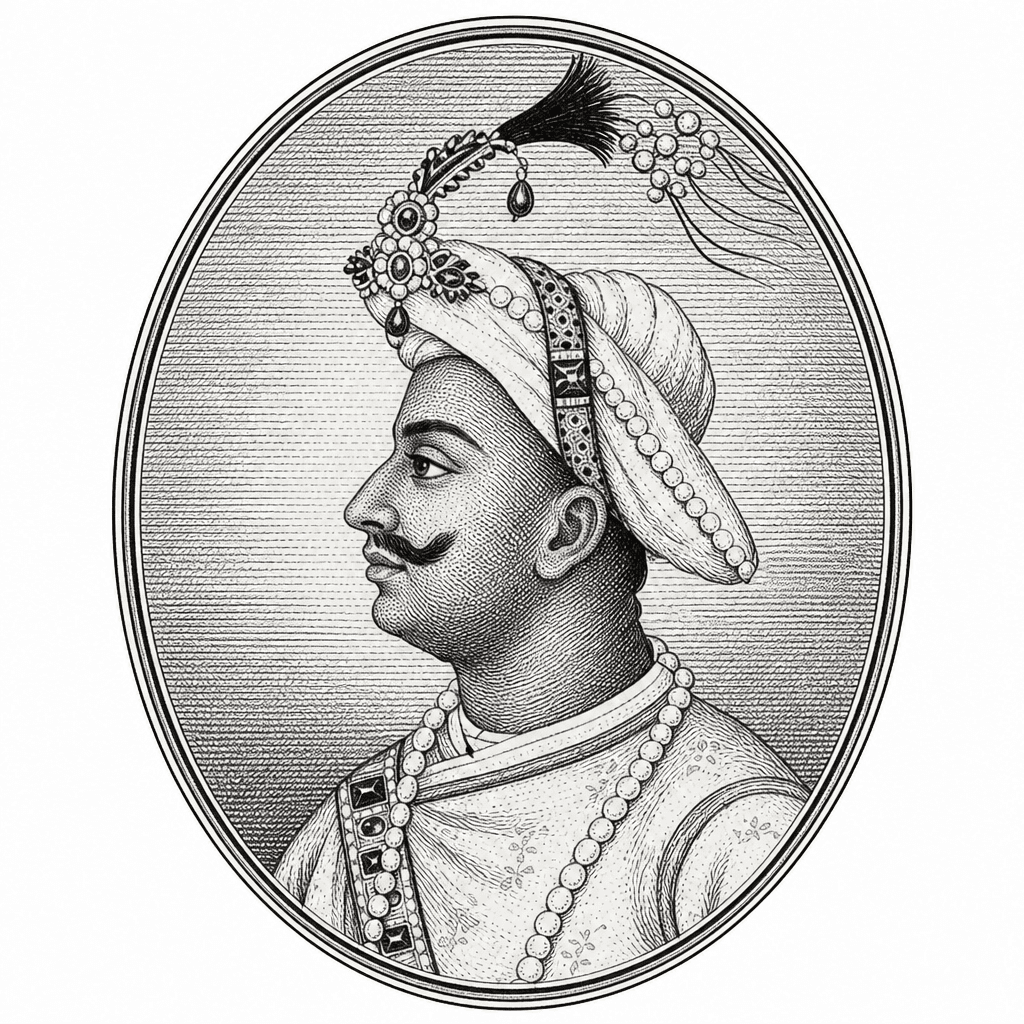
1751–1799
Tipu Sultan
Sultan of Mysore
The Tiger of Mysore, last Indian ruler to pose a genuinely existential threat to British power in South Asia — and the most ideologically committed French ally of the Revolutionary era.
THE TIGER OF MYSORE
Tipu Sultan, born Fateh Ali Sahab Tipu in 1751 near Bangalore, inherited from his father Hyder Ali not only the Kingdom of Mysore but a strategic framework: systematic resistance to British expansion through alliance with France. What Tipu added was ideological intensity. He did not merely ally with France as a military partner. He aligned himself with France as a revolutionary ideal.
His military innovations were formidable and specific. He expanded his father's iron-cased rocket corps from 1,200 to nearly 5,000 men, organised in specialist brigades with wheeled launchers capable of firing multiple rockets simultaneously and achieving ranges of up to two kilometres — far beyond contemporary European gunpowder technology. He codified their deployment in the military manual Fathul Mujahidin. When British forces captured Seringapatam in 1799, they took 600 launchers, 700 serviceable rockets, and 9,000 empty tubes. The technology directly inspired William Congreve's development of the Congreve rocket, used throughout the Napoleonic Wars.
His French alliance reached its most striking expression in 1794 when he established the Jacobin Club of Mysore at Seringapatam, planted a Liberty Tree in his palace garden, and began styling himself Citoyen Tipoo. His embassy to Versailles in 1787 had asked Louis XVI for a formal offensive-defensive alliance. His correspondence with Napoleon from Egypt in 1798 sought the same objective from the First Consul. Napoleon was interested: Talleyrand's report of February 1798 had proposed sending "a force of 15,000 men from Suez to India, to join the forces of Tipu-Sahib and drive away the English." Nelson destroyed the French fleet at the Nile in August 1798 and ended that calculation.
The Fourth Anglo-Mysore War opened in 1799. Seringapatam was stormed on 4 May. Tipu was found dead near the Water Gate, still in armour. He had refused the opportunity to escape. His reported last words: "Better to live one day as a tiger than a thousand years as a sheep."
Among the objects the British took from his palace was a life-size mechanical automaton — a tiger mauling a European soldier, fitted with an organ producing the sounds of the tiger's roar and the victim's screams. Built by French engineers for Tipu's court, it has been displayed at the Victoria and Albert Museum in London since 1808: one of the most remarkable surviving objects of French-Indian cultural collaboration in the colonial era.
The Pondy App
Take this guide with you
Offline maps, street-level history, restaurant picks, and hotel guides — everything on this site, in your pocket.