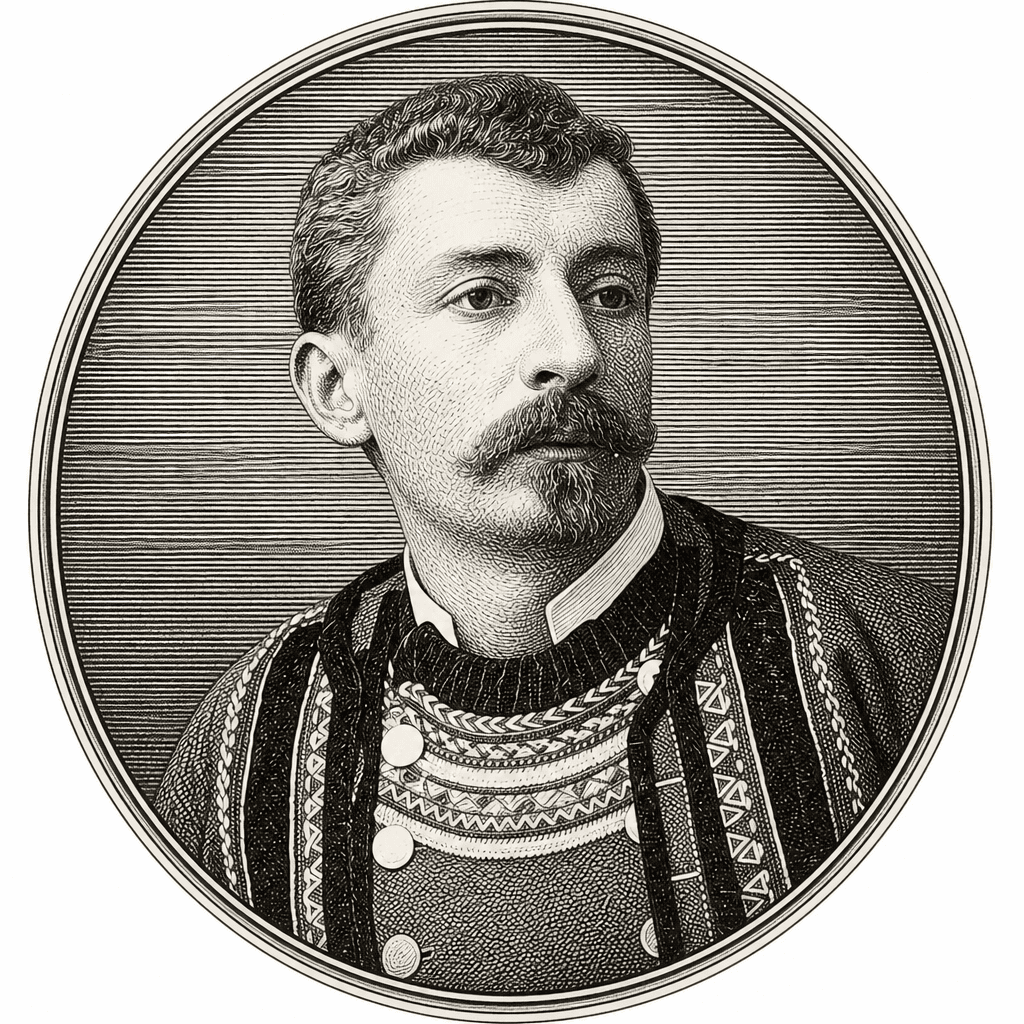
1850–1923
Pierre Loti
French Novelist and Naval Officer
The celebrated French novelist who arrived in Pondicherry by sea in 1899 and wrote the most atmospheric literary portrait of the city ever put on paper.
THE NOVELIST WHO CAME BY SEA
Pierre Loti — the pen name of Louis Marie Julien Viaud — was born in Rochefort in 1850 and lived his adult life simultaneously as a French naval officer and as one of the most widely read novelists of the Belle Époque. Wherever the navy sent him, he wrote: Japan gave him Madame Chrysanthème (1887), Brittany gave him Pêcheur d'Islande (1886), Turkey gave him Aziyadé (1879). When the navy sent him toward the Indian Ocean in November 1899, he was at the height of his celebrity — a member of the Académie française since 1891, recognised across Europe as the master of a literary impressionism that rendered foreign places with physical immediacy.
He arrived at Pondicherry the way French ships had arrived for two centuries: approaching from the roadstead, the Coromandel Coast rising slowly from the sea, the towers of Notre-Dame des Anges visible above the waterline before the city itself appeared. It was a deliberate approach — the approach of a man who understood that the right way to enter a place is from the direction it was designed to receive visitors. He attended Mass at Notre-Dame des Anges, walked Rue Dumas and Rue de la Marine, and moved between the White Town and the Tamil streets of the Black Town with the attentiveness of a man trained in close observation of foreign environments.
The book that came from his Indian journey, L'Inde (sans les Anglais) (1903), announces its method in its title. India without the English: an itinerary that deliberately avoided the centres of British power and sought instead the French settlements, the princely states, and the sacred cities the East India Company had not absorbed. His portrait of Pondicherry — its hybrid French-Tamil character, the church towers above the beach, the mixture of French and Indian faces in the cathedral congregation — remains the most vivid literary account of the city under the Third Republic.
He died in Hendaye in June 1923. L'Inde (sans les Anglais) is less read today than his Breton and Turkish novels, but for Pondicherry it is irreplaceable: a literary walk through a city that no longer exists in that form, written by the only significant French author who came here and paid full attention.
The Pondy App
Take this guide with you
Offline maps, street-level history, restaurant picks, and hotel guides — everything on this site, in your pocket.