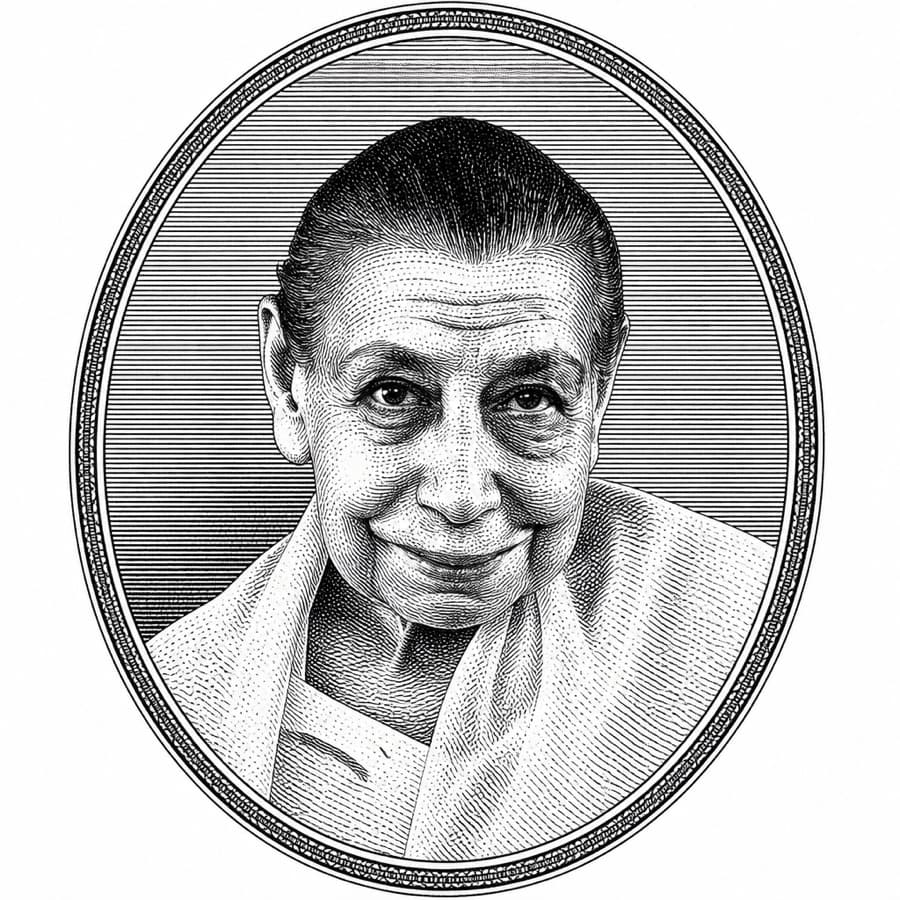
1878–1973
Mirra Alfassa
Co-founder of the Sri Aurobindo Ashram; 'The Mother'
The Parisian painter who arrived in Pondicherry in 1914, recognised Sri Aurobindo as the being she had seen in her inner life for years, and spent the next fifty-nine years building what became the spiritual centre of the White Town.
THE MOTHER
Mirra Alfassa was born in Paris on 21 February 1878, into a family of Egyptian-Turkish origin that had made its way from Alexandria to the 4th arrondissement. She trained as a visual artist, moved in the Belle Époque intellectual milieu, co-founded a Parisian spiritual journal called the Revue Cosmique in 1904, and had, for years before leaving Europe, a series of inner experiences she had no framework to interpret. She arrived in Pondicherry on 29 March 1914 — accompanying her second husband Paul Richard, who was standing as a political candidate in the French settlement — and met Sri Aurobindo for the first time. She later said she recognised him immediately as the figure she had been encountering in her inner life since childhood.
She spent a year in Pondicherry, collaborating with Sri Aurobindo on the spiritual journal Arya, then was pulled back to Europe by the First World War. She spent four years in Japan. She returned to Pondicherry on 24 April 1920, alone, and did not leave again. On 24 November 1926 — the Day of Siddhi — Sri Aurobindo formally installed her as "the Mother," his spiritual collaborator and equal, and withdrew into complete seclusion, entrusting the Ashram entirely to her direction. She ran it for forty-seven years.
Under her governance the Ashram grew from a small community of disciples into an institution of nearly 1,200 members, with departments of education, agriculture, music, printing, physical culture, and industry. She gave the talks collected in seventeen volumes of Collected Works. From 1951, her daily conversations with the disciple Satprem — a French wartime survivor whom Governor Charles Baron had brought to Pondicherry in a state of near-collapse — were recorded and compiled as L'Agenda de Mère, thirteen volumes of inner exploration that constitute one of the most extraordinary documents of twentieth-century spiritual life.
In late September 1947, she was present when Sri Aurobindo received the French cultural mission led by Maurice Schumann, future Foreign Minister of France. After the frugal evening meal, she challenged Schumann to a game of ping-pong. She won decisively. She then spent the rest of the evening questioning him in close detail about post-war France and the political situation in Alsace. Schumann, then in his mid-thirties, was struck by her duality: completely absorbed in the Ashram's inner work and simultaneously fully present to France, the country of her birth. When told of her death in 1973 at ninety-five, he exclaimed: "At 70 she was playing ping-pong as if she were 18."
She initiated Auroville in 1968: a township intended to embody the ideal of human unity, built on the red laterite plateau north of Pondicherry. At the inauguration ceremony, representatives from 124 nations and 23 Indian states brought soil from their homelands and mingled it at the central point. She was ninety and did not attend in person. She died in Pondicherry on 17 November 1973. Her tomb is beside Sri Aurobindo's in the Ashram courtyard, beneath a frangipani tree. Thousands come to it every day.
The Pondy App
Take this guide with you
Offline maps, street-level history, restaurant picks, and hotel guides — everything on this site, in your pocket.