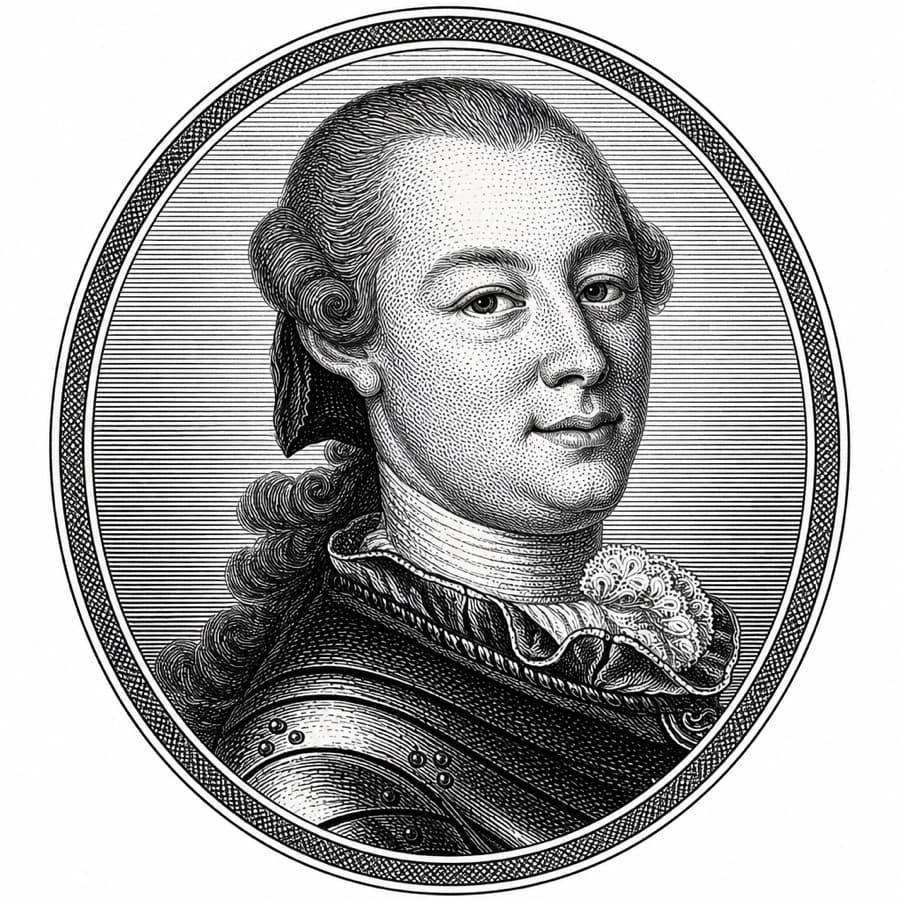
1634–1706
François Martin
Founder of Pondicherry; Director-General of French India
The Paris merchant who arrived at a fishing village in 1674 with six men, held it against the Dutch, built it into a city, lost it, built it again, and died at his desk — the man who made Pondicherry.
THE MAN WHO MADE PONDICHERRY
François Martin was born in Paris in 1634, the natural son of a merchant, and left France in March 1665 as a junior Company trader aboard the frigate l'Aigle Blanc — never to return. He spent four years at sea and in Madagascar before landing at Surat in 1669 and making his way down the Coromandel Coast. He was not yet the founder of anything; he was a meticulous accountant in a failing commercial enterprise, navigating Dutch hostility, Mughal indifference, and chronically undercapitalised French ambitions.
The founding moment came on 14 January 1674, when he joined the small French force at Pondicherry — then barely a fishing village — to organise supplies for the besieged French position at San Thomé. When San Thomé fell on 30 August 1674 and the French evacuated, Martin stayed. With six men. Against everyone's advice, including the Indian governor who had granted the French their foothold. His reasoning was simple: if they left, they would never be permitted back. He waited with six men while the Dutch consolidated, while every calculation pointed to departure. He did not leave.
That decision — to hold Pondicherry with six men against the current of all events — is the true founding moment of permanent French India. Martin spent the next thirty years turning it into a city.
His method was patient and exact where Dupleix's would later be ambitious and political. But in September 1676, at the fortress of Valdaour, he took a step that the historian Froidevaux identified as making him Dupleix's direct forerunner: he led a French force in a night assault on behalf of his Indian protector Chirkhan Loudy, exacting written guarantees first, then seizing the fortress and securing French Pondicherry's position in the same stroke. Military support for an Indian ally in exchange for political protection and territorial acknowledgement — the logic Dupleix would deploy at continental scale seventy years later, practised here in miniature by a man with thirty-odd soldiers and no metropolitan backing.
In September 1693 the Dutch attacked during the Nine Years' War, overwhelmed Pondicherry's defences, and carried Martin as a prisoner to Batavia. He negotiated his release, took refuge with his family at Chandernagore in Bengal — where Dupleix would govern forty years later — and waited. The Treaty of Ryswick (1697) required the Dutch to restore Pondicherry to France. Martin returned in 1699 to find a settlement systematically stripped. He rebuilt it. It was the second time he had built Pondicherry from near-nothing.
He died in office on 30 December 1706, buried in the fort he had built at the heart of the city he had founded. He had left Paris at thirty and never went back. Alfred Martineau, who edited his Mémoires for publication, called him "l'homme des réalisations pratiques, en dehors de toute idéologie" — a man of balanced judgment, without vanity or ideological ambition. His three volumes of Mémoires, kept across four decades, are the most important single primary source for the history of early French India. The street grid of the White Town follows the lines Martin laid.
The Pondy App
Take this guide with you
Offline maps, street-level history, restaurant picks, and hotel guides — everything on this site, in your pocket.