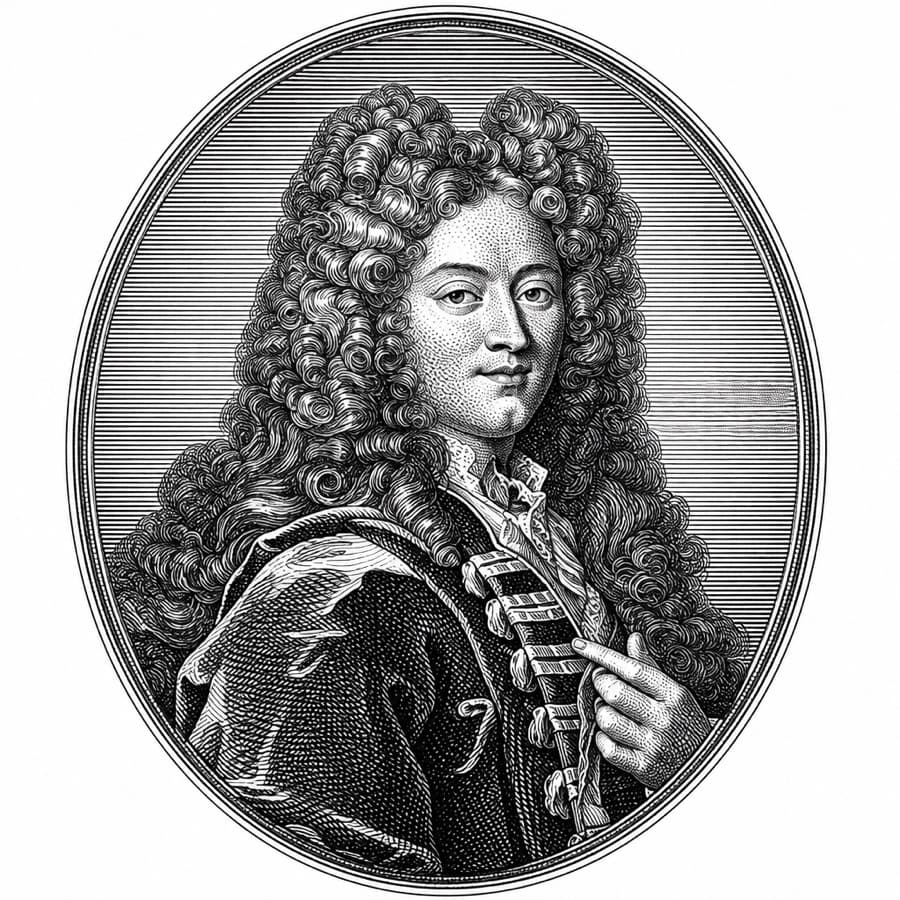
1725–c.1792
Guillaume Le Gentil
French Astronomer; Member, Académie des Sciences
The astronomer who travelled halfway around the world twice to observe the transit of Venus, missed it both times — once because of a war, once because of a cloud — and left instead the most vivid European portrait of Pondicherry in the 1760s.
THE UNLUCKIEST ASTRONOMER IN HISTORY
Guillaume Le Gentil left France on 26 May 1760 to observe the transit of Venus across the solar disc, scheduled for 6 June 1761. The measurement — Venus appearing as a small black dot moving across the sun — offered the best available means of calculating the earth-sun distance, the fundamental unit of the solar system. Edmund Halley had urged the world's astronomers to observe it from multiple global positions simultaneously. The French Académie des Sciences assigned Le Gentil to Pondicherry.
He arrived in Mauritius in July 1760. The Seven Years' War had reached the Coromandel Coast: Pondicherry was under pressure and no ship could take him there. He eventually found a frigate heading toward the coast — but it spent five weeks drifting on dying monsoon winds. On 24 May 1761 it put in at Mahé, where he learned that both Mahé and Pondicherry had fallen to the British. The ship turned back for Mauritius. On 6 June 1761, from the rolling deck, Le Gentil watched the transit of Venus through his telescope. A ship's deck provided nothing approaching the stable platform the Académie's precision measurements required. After a year of travel, he had produced nothing scientifically useful.
The next transit was in 1769 — eight years away. He resolved not to go home. He spent the intervening years charting coastlines, studying monsoons, mapping Madagascar, sailing to Manila, and assembling observations on tides, soils, and regional astronomy. Rumours reached Paris that he was merely trading and growing rich; the Académie's records defended him gently: the only treasure he brought back was data.
He landed at Pondicherry on 27 March 1768 — fourteen months before the second transit. He found a city still rebuilding from the catastrophic British demolition of 1761. Governor Law de Lauriston received him warmly, helped him construct an observatory atop a ruined fort, and the English at Madras even sent him an excellent telescope. The months through May 1769 were ideal. Every morning until 3 June was clear. On the evening of 2 June, he and the Governor together observed an emersion of a satellite of Jupiter — perfectly. Compliments were already being pressed upon him.
On the morning of 3 June 1769, at the precise moment the transit began, a squall appeared from nowhere. The sun disappeared. It re-emerged at 7h 30min — thirty minutes after Venus had completed its passage. The rest of that day, and the days following, were beautiful. He wrote: "J'avais fait près de dix mille lieues; il semblait que je n'avais parcouru un si grand espace de mers en m'exilant de ma patrie, que pour être spectateur d'un nuage fatal." He was more than two weeks in what he called a singular dejection and almost could not take up his pen.
He stayed on through 1769 and into 1770, recovering from fever and dysentery, and doing something unexpected. A Brahmin mathematician visited him, sat on the ground with a bundle of palm-leaf manuscripts and a bag of cowrie shells, and in three-quarters of an hour calculated the phases of a lunar eclipse. Le Gentil checked it against his own tables: the agreement was striking. He spent months learning the Brahmin computational method, which eventually provided the empirical foundation for a major controversy about the antiquity of Indian astronomy that has never been fully resolved.
He sailed for home on 1 March 1770. A hurricane off Réunion nearly sank his ship on the return. A British warship intercepted him; he escaped through the diplomatic gift of a large sack of potatoes. He crossed the Pyrenees on 8 October 1771, "after eleven years, six months, and thirteen days of absence." In Paris he found his wife had remarried, believing him dead, and his estate had been plundered. He recovered his position at the Académie, remarried, had a daughter, wrote his memoirs, and died around 1792. His transit observations contributed nothing to science. His account of Pondicherry in the 1760s — the dress, the funerals, the temples, the pilgrimage rest-houses beside the roads — is irreplaceable.
The Pondy App
Take this guide with you
Offline maps, street-level history, restaurant picks, and hotel guides — everything on this site, in your pocket.