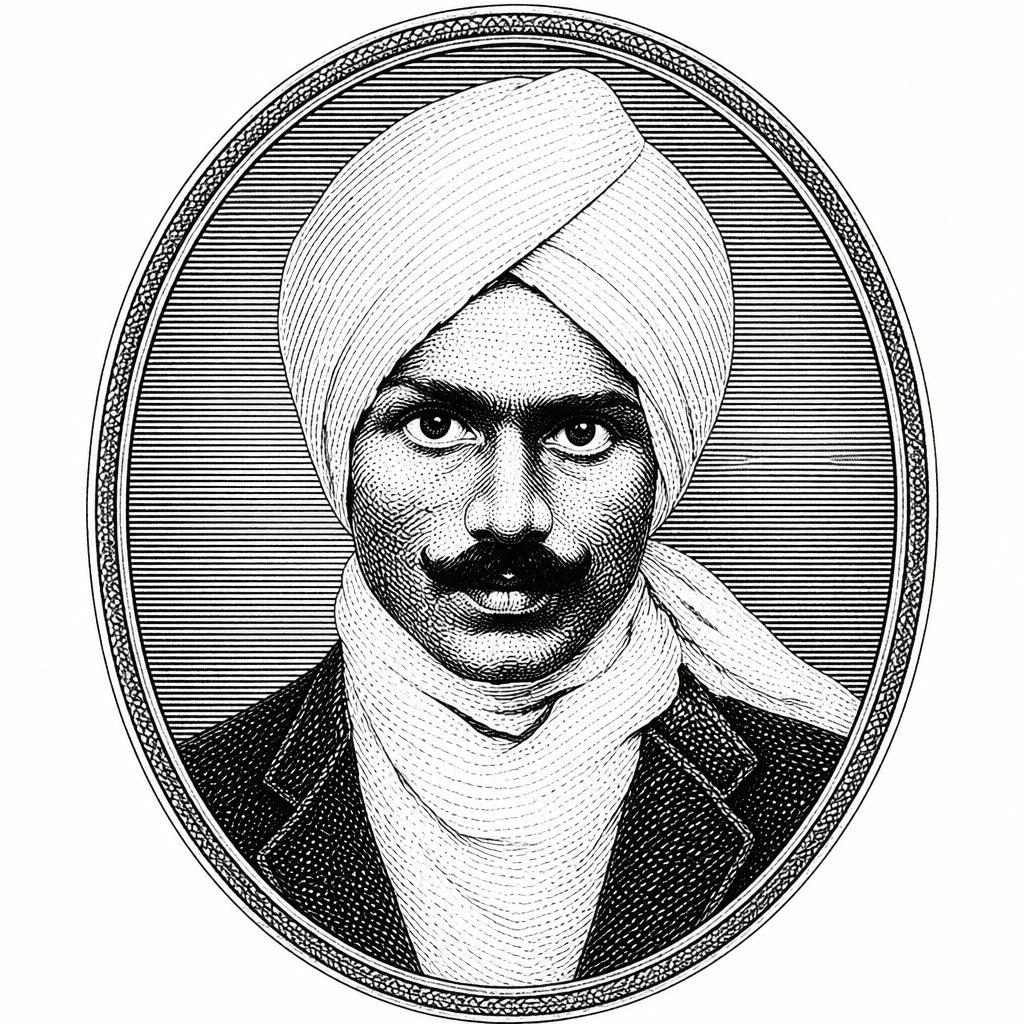
1882–1921
Subramania Bharati
Tamil Poet; Nationalist
The greatest Tamil poet of the modern era, who lived in Pondicherry from 1908 to 1919 as a fugitive from British India and wrote some of the finest poetry in the Tamil language in a small house near the seafront.
THE POET IN EXILE
Subramania Bharati was born on 11 December 1882 in Ettayapuram, a small principality in southern Tamil Nadu, into a Tamil Brahmin family. A child prodigy who composed Tamil verse from the age of seven, he was given the honorary title Bharati (gifted one) by the Ettayapuram court. He came under the influence of the Swadeshi movement and the radical nationalism of Bal Gangadhar Tilak, wrote and edited nationalist Tamil newspapers in Madras, and by 1908 calculated that arrest was imminent. He crossed into French India and took up residence in Pondicherry.
French sovereignty offered protection that British India could not override. The colonial administration had no obligation to extradite individuals sought by British authorities for offences that were not crimes under French law. Pondicherry was filling up with Indian nationalists for exactly this reason: Sri Aurobindo arrived two years later, in 1910, and became Bharati's neighbour and occasional interlocutor. Bharati translated some of Aurobindo's English writings into Tamil; the two men — both political exiles turning increasingly inward — occupied adjacent corners of an unusual intellectual world.
Bharati lived in poverty, supporting his family through journalism and the charity of friends, but wrote at extraordinary pace. The Pondicherry years were the most productive of his life. Panchali Sabatham (1912), an epic poem retelling the Mahabharata episode in which Draupadi swears vengeance — reinterpreted as an allegory of India's colonial subjugation and coming liberation — was immediately celebrated as a masterwork. Kuyil Pattu, his lyric sequence about a cuckoo, brought formal innovation to Tamil literary tradition. Kannan Pattu, his devotional songs to Krishna, are still sung across Tamil-speaking communities worldwide.
He returned to British India in 1919, was arrested briefly, and died in Madras in September 1921, aged thirty-eight. The cause of death was injuries sustained when a temple elephant he had befriended and regularly fed — at the Parthasarathy Temple in Triplicane — struck him; he never recovered. The Government of India acquired the copyright to his works in 1949, placing them in the public domain; his birthday, 11 December, is observed across Tamil Nadu as Tamil Poet Day. Bharathi Park, the great central garden of the White Town — formerly the French colonial Jardin de la Compagnie — bears his name. His house on Eswaran Koil Street is maintained as a heritage site by the Puducherry Tourism Department.
The Pondy App
Take this guide with you
Offline maps, street-level history, restaurant picks, and hotel guides — everything on this site, in your pocket.