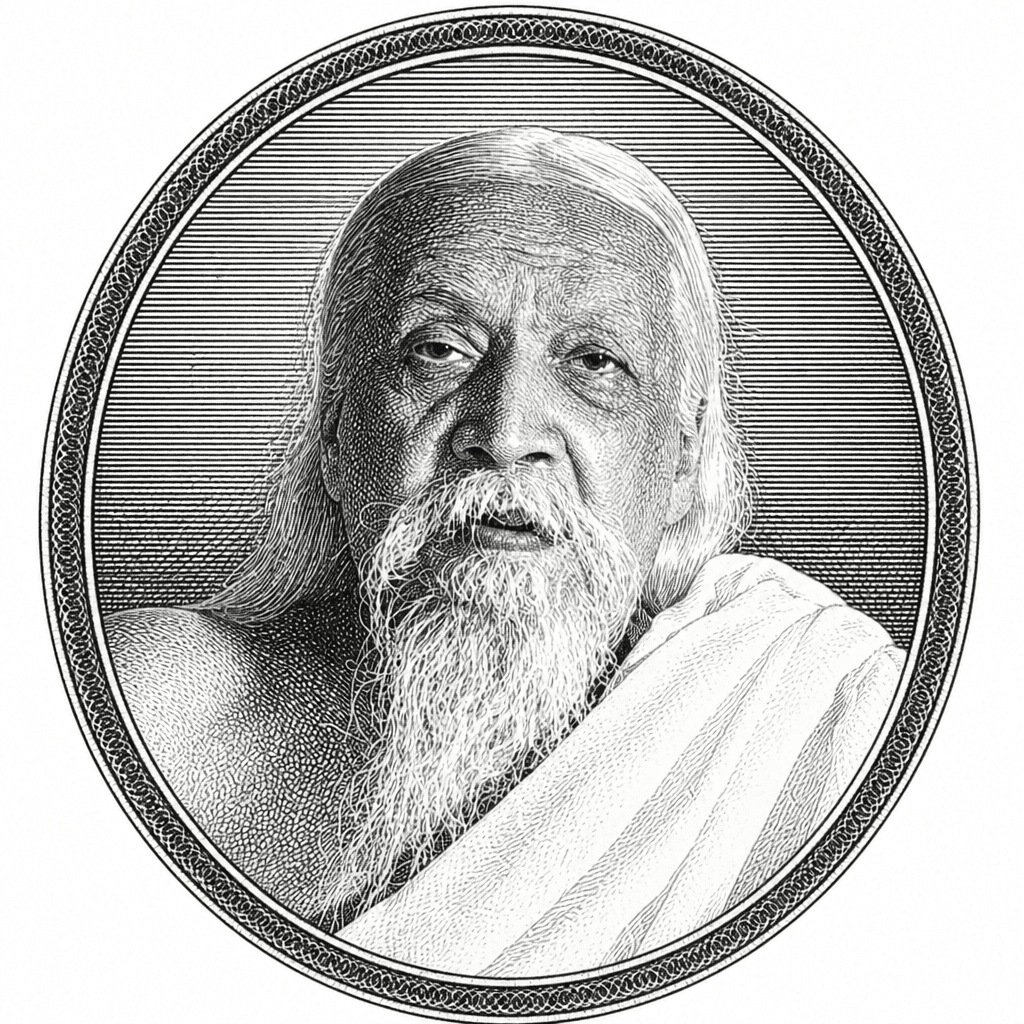
1872–1950
Sri Aurobindo
Philosopher, Yogi, Nationalist
The Indian nationalist who arrived in Pondicherry in 1910 as a political fugitive, never left, and spent the next forty years building one of the twentieth century's most significant spiritual traditions — in a city that sheltered him because it flew a different flag.
FROM REVOLUTIONARY TO RISHI
Sri Aurobindo was born Aurobindo Ghose in Calcutta on 15 August 1872 — a date that, seventy-five years later, independent India would choose as the day of its own birth. His father sent him to England at the age of seven; by the time he returned to India in 1893, he was Cambridge-educated, fluent in approximately twelve languages, and had deliberately failed the Indian Civil Service horse-riding practical to avoid entering a service he had been educated to join. He spent the 1890s and early 1900s in Baroda teaching and writing, making clandestine contacts with revolutionary networks, and coming to believe that India required complete independence rather than the graduated autonomy the Congress moderates were seeking.
His year in Alipore prison in 1908, following arrest in the Conspiracy case, transformed him. He described visions of Krishna in the walls of his cell, in the warders, in the judge — and received what he understood as divine instruction that India's freedom was assured without him, and that his calling was different: the development of a yoga aimed not at escape from the world but at the transformation of human consciousness itself. When the threat of renewed arrest came in 1910, he received what he described as a divine instruction to go to Pondicherry. He arrived on 4 April 1910 and never left.
With Mirra Alfassa, the French woman who joined him permanently in 1920 and became known as the Mother, he developed Integral Yoga. On 24 November 1926 — the Day of Siddhi, or Victory — they marked what they understood as a decisive inner event: Sri Aurobindo installed Mirra Alfassa as the Mother of the spiritual community and withdrew into strict seclusion from which he did not emerge until his death. From his room, he guided hundreds of disciples through correspondence and worked on Savitri, the epic poem he considered his central creative achievement, alongside the philosophical masterwork The Life Divine.
On 15 August 1947 — his own seventy-fifth birthday — he broadcast his "Five Dreams" to All India Radio: the unity of India, the resurgence of Asia, a world union, the gift of India's spiritual heritage to the world, and a next step in human evolution. The first was already broken: Partition had divided the subcontinent the same day.
In September 1947, for the first time since 1928, he received outside visitors: Maurice Schumann, wartime voice of the Free French, and Governor Baron. After the meeting, the Mother challenged Schumann to a game of ping-pong and won decisively, then spent the rest of the evening asking him about post-war France. Sri Aurobindo died on 5 December 1950. The Ashram remains the largest institution in the White Town. Auroville, the international township inspired by his vision of human unity, was inaugurated in 1968 on the red laterite plateau north of the city.
The Pondy App
Take this guide with you
Offline maps, street-level history, restaurant picks, and hotel guides — everything on this site, in your pocket.