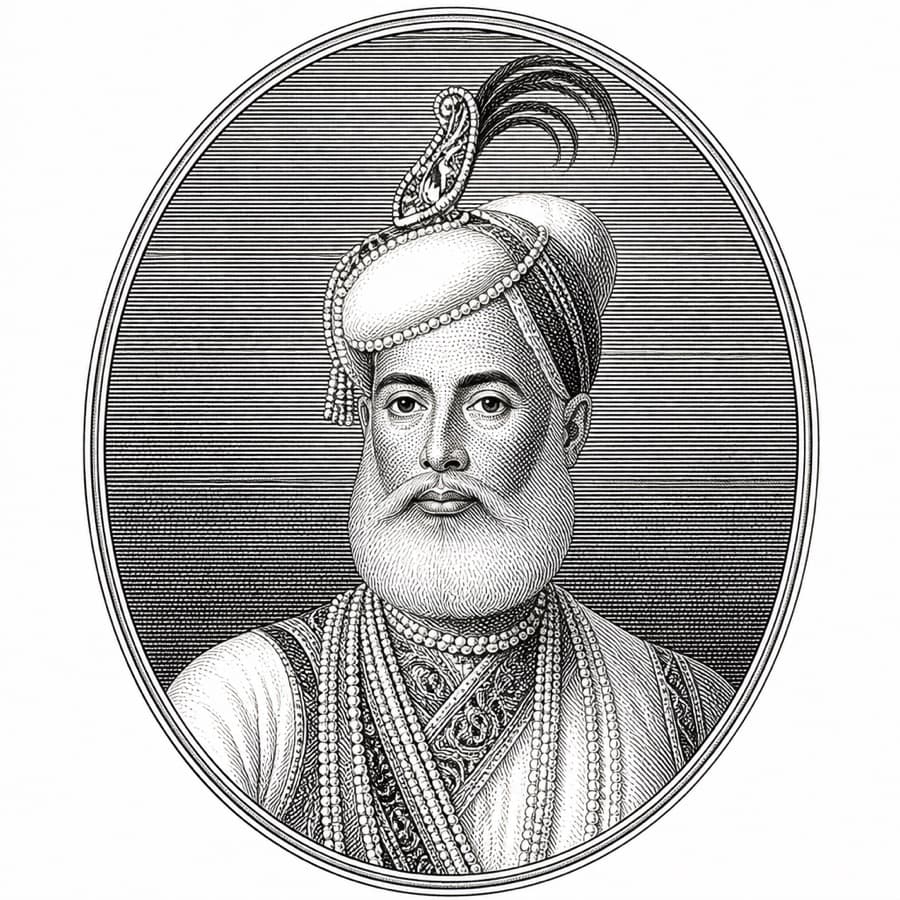
1717–1795
Muhammad Ali Khan Wallajah
Nawab of the Carnatic
The British-backed Nawab whose forty-six years of survival — first in the fortress of Trichinopoly, then in the labyrinth of Company debt — defined what the British presence in South India would eventually become.
THE NAWAB IN THE FORTRESS
Muhammad Ali Khan Wallajah was twenty-two when his father Anwaruddin was killed at the Battle of Ambur on 3 August 1749 and the French-backed Chanda Sahib was proclaimed Nawab of the Carnatic. He fled south to Trichinopoly — the great rock fortress on the Kaveri — with a small British-supported force and dug in. His claim to the Nawabship had no military force behind it; what it had was a British East India Company that understood, with increasing clarity, that a French-dominated Carnatic was a strategic threat it could not accept.
He held Trichinopoly while the Second Carnatic War was fought around him. Dupleix sent French-led forces to take the fortress and eliminate him. They came close. The military position was desperate at several points. The decisive relief came not at Trichinopoly itself but four hundred kilometres to the north, where Robert Clive — then twenty-six, with two hundred men — seized Arcot, the traditional seat of the Nawabs of the Carnatic, in September 1751 and held it for fifty days against all French-allied attempts to retake it. The symbolic effect of Arcot was as important as the military: it demonstrated that the British-backed cause could hold, and diverted French resources from the south just long enough.
When Chanda Sahib was captured and beheaded in June 1752, Muhammad Ali became the undisputed Nawab of the Carnatic. The French political construction in the south — Dupleix's protectorate, years in the building — collapsed in a single afternoon. Muhammad Ali moved from Trichinopoly to Madras, was recognised by the Nizam of Hyderabad, confirmed by the British East India Company, and settled in for a reign that would last another forty-three years.
The cost of that reign was the progressive surrender of political independence. He borrowed enormous sums from the Company and from private British merchants to finance his wars and his court. The debts were used as leverage: control over revenue collection, military access, diplomatic subordination. By the later decades of his reign the Carnatic was effectively a British protectorate, Muhammad Ali a wealthy but constrained figurehead at the centre of a web of financial obligations he could no longer manage. He witnessed the fall of Pondicherry in 1761, the four subsequent British occupations of the French capital, and the rise of Hyder Ali and Tipu Sultan. He died at Madras in 1795, aged seventy-eight, having outlived his French enemies by more than three decades and having enabled, step by patient step, the British paramountcy that replaced them.
His name is least familiar to history because his achievement was survival rather than conquest. But without him — without the British decision to back his claim and the French decision to oppose it — Dupleix's protectorate might have held, and the subsequent history of southern India would have been entirely different.
The Pondy App
Take this guide with you
Offline maps, street-level history, restaurant picks, and hotel guides — everything on this site, in your pocket.