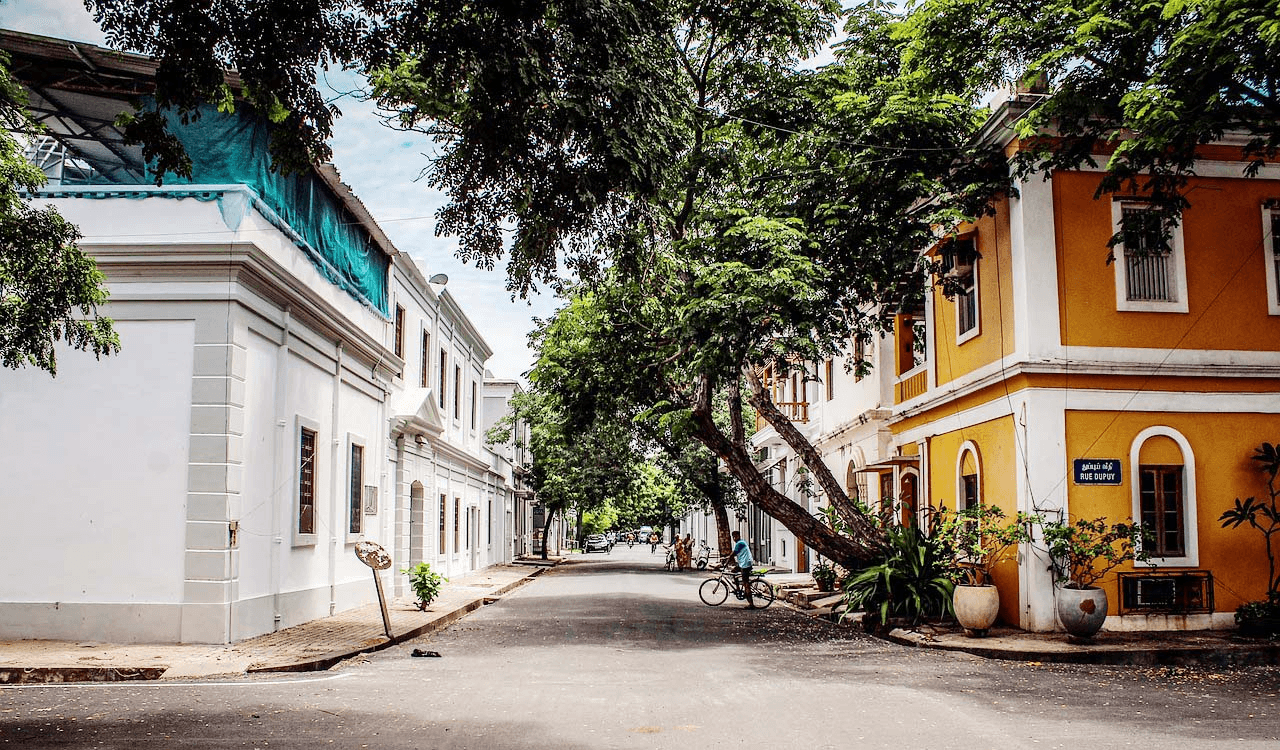
East–West Street
Rue Lally-Tollendal
Named after: Thomas Arthur de Lally-Tollendal, last French military governor (1702–1766)
Welcome to Rue Lally-Tollendal, named after the commander who surrendered Pondicherry in January 1761, was brought back to France in chains, tried for treason, and beheaded in Paris on 9 May 1766. Voltaire campaigned for his innocence. The Paris Parlement agreed, twelve years after the execution. France named a street after him anyway.
You are walking on a street named after a man France killed. Thomas Arthur de Lally-Tollendal (1702–1766) came from the Irish Jacobite diaspora: his father had followed James II into French exile after 1688, and Lally grew up French in name, Irish in blood. He distinguished himself at the Battle of Fontenoy in 1745 and arrived in India in April 1758 with a mandate to reverse French decline after Dupleix's recall.
The mission was close to impossible before he started. British sea power had consolidated. Robert Clive had won Plassey. The money and ships from Paris never arrived in sufficient numbers. Lally compounded the structural problems with decisions that historians have never forgiven: most critically, he recalled Bussy from Hyderabad, dissolving the French protectorate in the Deccan to concentrate forces in the Carnatic. Bussy had held that position for eight years with a few thousand men. The moment he left, it collapsed. The siege of Madras failed (December 1758 to February 1759). The defeat at Wandiwash came on 22 January 1760. Pondicherry fell in January 1761 after a five-month siege.
Lally returned to France expecting to answer questions. Instead he was arrested. The civilian community of Pondicherry, whom he had treated badly during the siege, had provided testimony against him. On 9 May 1766 he was beheaded in Paris. Voltaire read the trial record and concluded it was judicial murder. He published Fragments sur l'Inde in 1773. In 1778 the Paris Parlement annulled the conviction. Lally's son spent his life on the rehabilitation campaign. The street named after him sits alongside those of Dupleix and Bussy, his colleagues and contemporaries. The White Town kept everyone.
Notable on this street
- His most criticised decision: recalling Bussy from Hyderabad in 1758. Bussy had held the Deccan protectorate for eight years. It collapsed within months of his departure. Lally never had an answer for this.
- He was beheaded in Paris on 9 May 1766. Voltaire called it judicial murder and said so publicly. The Parlement agreed in 1778. Lally did not live to hear it.
- His street runs east-west across the grid that Law de Lauriston rebuilt after the siege Lally lost. Every morning the sun rises over the street named after the man who surrendered this city.
- Lally's son, Trophime-Gérard de Lally-Tollendal, spent decades rehabilitating his father's name. He succeeded. He also became a moderate voice during the French Revolution, opposed to the Terror.
The Pondy App
Take this guide with you
Offline maps, street-level history, restaurant picks, and hotel guides — everything on this site, in your pocket.