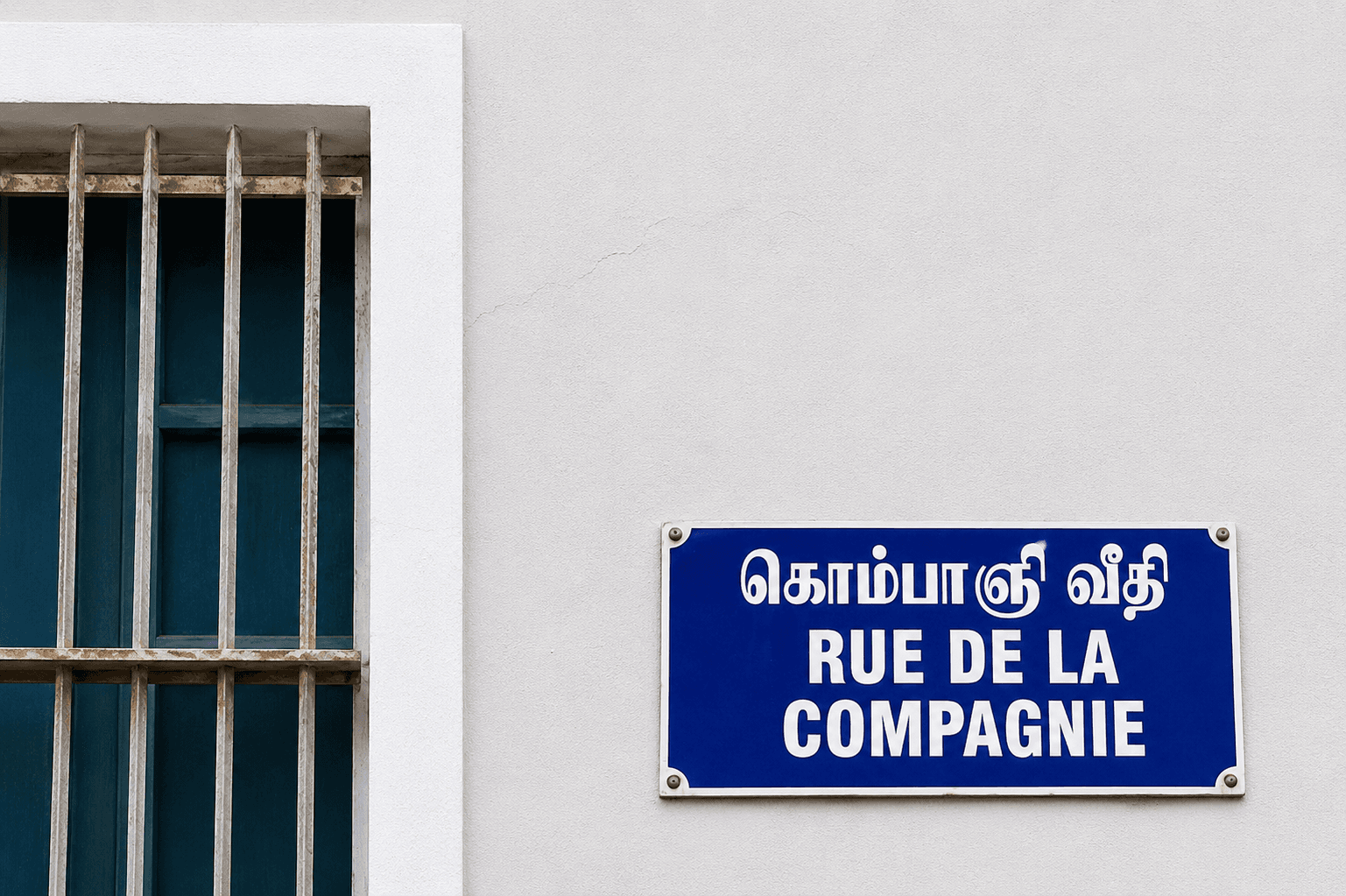
East–West Street
Rue de la Compagnie
Named after: Compagnie des Indes (French East India Company) (Founded 1664)
Welcome to Rue de la Compagnie, named after the Compagnie des Indes, the French East India Company founded in 1664. Before there were governors and generals, there was a trading company. It created this city, sustained it for a century, and in 1754 made the decision that ended French India's best chance of becoming something larger.
You are walking on a street named not after a person but after a corporation. The Compagnie des Indes Orientales was founded by Jean-Baptiste Colbert in 1664 as a state-backed monopoly: France's answer to the Dutch and English trading companies that were accumulating wealth and territory across Asia while France watched. In 1666 the Mughal emperor Aurangzeb granted it trading rights, and the Company set up its first Indian establishment at Surat. Southern operations from Pondicherry began in 1673: cotton and textiles were the main trade items, flowing out of this coast to Europe for the next eighty years. It financed François Martin's settlement here and sustained the colony through wars, occupations, and sieges for a century.
The tension at the heart of French India was always the tension between the Company's shareholders and the governors on the ground. The Company wanted cotton, spices, and dividends. Dupleix wanted territorial sovereignty and a revenue base independent of trade. For twelve years he built a protectorate across the Carnatic and Deccan, placing French-backed princes on thrones and collecting grants of territory in return. At its peak in 1750, Pondicherry was constitutionally the capital of the Deccan.
In 1754 the Company made its decision: recall Dupleix, send Godeheu to negotiate peace, return to commerce. It was rational from a shareholder perspective and catastrophic from every other one. The British drew no equivalent restraint on themselves. In 1769, unable to sustain profitable ventures through decades of war, the Compagnie was absorbed by the French crown. France then governed its Indian comptoirs directly, but the moment was gone. This street remembers the institution that built the city and chose not to keep the empire.
Notable on this street
- The only street in the grid named for an institution rather than a person. Before Dupleix and Suffren and Bussy, there was a balance sheet. This street acknowledges that.
- The Company recalled Dupleix in 1754. The British, under Clive, drew no equivalent restraint on themselves. That asymmetry is why you are in an Indian Union Territory and not in French India.
- Colbert founded the Compagnie in 1664. The French crown absorbed it in 1769. In 105 years it created Pondicherry, sustained it, and outlived its own usefulness. France then governed directly, but too late.
- The Company's logic was commercial. Dupleix's logic was imperial. They were irreconcilable. The Company won the argument and lost the empire.
The Pondy App
Take this guide with you
Offline maps, street-level history, restaurant picks, and hotel guides — everything on this site, in your pocket.