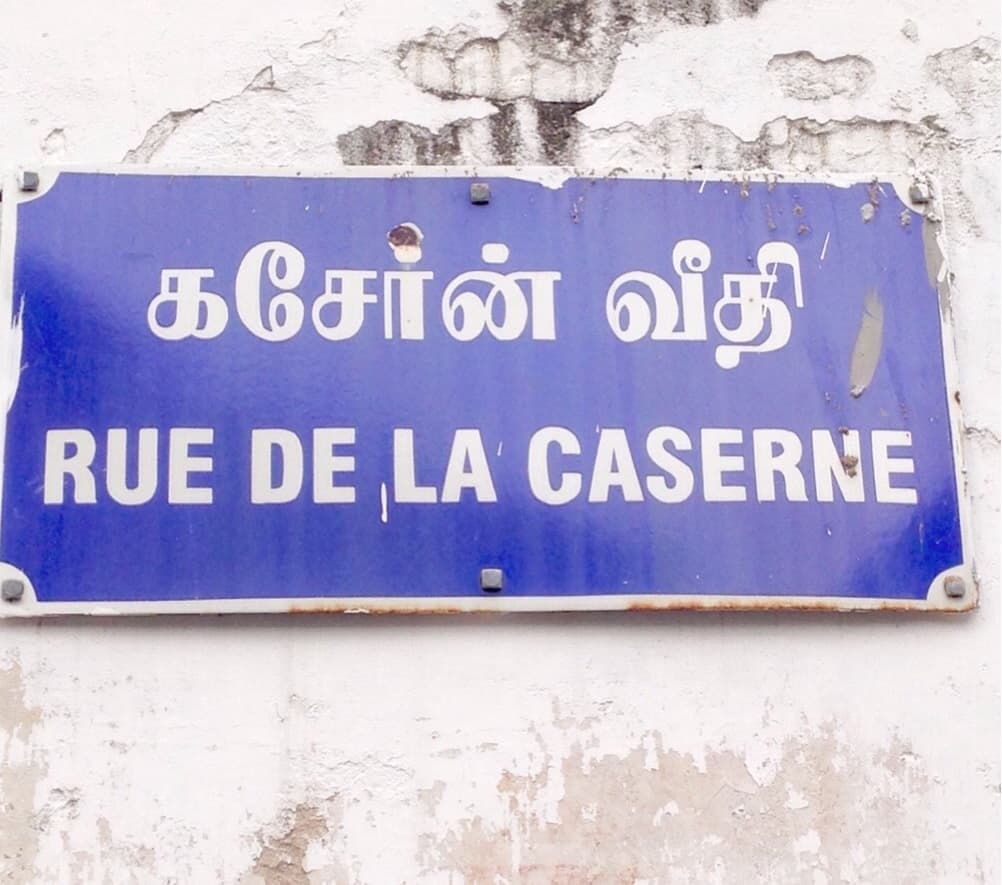
East–West Street
Caserne Street
Also known as: Rue de la Caserne
Named after: La Caserne (the barracks), the military garrison of French colonial Pondicherry
Welcome to Caserne Street. Caserne is French for barracks. This small street is named after the military garrison that housed the soldiers of French India through four British sieges, three occupations, and two centuries of imperial ambition. The men who held Pondicherry, and the men who surrendered it, were quartered here.
Rue de la Caserne was one of the original streets of the White Town grid, named after the barracks of the French colonial garrison. The garrison was the physical foundation of the French presence in India: without soldiers, there was no comptoir, no governor, no trading empire. The barracks housed the European infantry, the artillerymen who manned the fort's guns, and the officers who commanded the Indian sepoys trained in European military discipline.
The garrison's record in Pondicherry was one of remarkable resistance and repeated defeat. The city was besieged and taken by the British in 1748, returned under the Treaty of Aix-la-Chapelle. Besieged again in 1760-1761, surrendered in January 1761 after fourteen months, then razed to the ground. Taken again in 1778 after ten weeks of resistance under Bellecombe, returned in 1783. Taken once more in 1793 during the French Revolutionary Wars. Each time, the men of the Caserne held as long as they could and then marched out under terms.
The barracks that gave the street its name are long gone, replaced by the colonial houses and quiet lanes of the modern White Town. But the name remains: a small street between La Bourdonnais and Surcouf, carrying the memory of the garrison that was the armed argument for French India's existence.
Notable on this street
- Caserne means barracks. This street is named after the military garrison that was the armed foundation of French colonial Pondicherry.
- Rue de la Caserne was one of the original streets of the White Town grid, named in the early colonial period alongside Rue de la Marine and Rue Dumas.
- The garrison defended Pondicherry through four British sieges: 1748, 1761, 1778, and 1793. They held as long as they could each time, and surrendered when they had to.
- After the 1761 siege, the British systematically demolished the barracks along with the rest of the White Town. What was rebuilt was never quite the same.
- A small street with a large military history. The barracks are gone. The name stayed.
The Pondy App
Take this guide with you
Offline maps, street-level history, restaurant picks, and hotel guides — everything on this site, in your pocket.