Monument & Street
Golconde
Built: Completed 1942
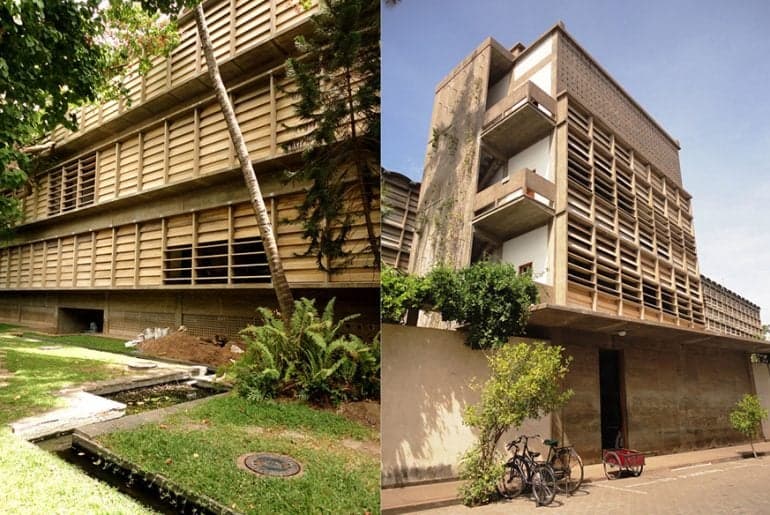
India's first reinforced, cast-in-place concrete building, completed in 1942 by a Japanese-American architect who arrived as a site supervisor and left as a disciple of Sri Aurobindo. No mechanical cooling. The sea breeze does the work. Golconde is a private ashram residence and one of the most significant buildings in modern architectural history.
The architect and his apprentice. Antonin Raymond was a Czech-American architect who had come to Japan in 1919 as Frank Lloyd Wright's project architect for the Imperial Hotel in Tokyo. He stayed, founded his own practice, and took on a young Japanese-American assistant named George Nakashima. While working for Raymond, Nakashima traveled Japan extensively and learned about traditional construction. In 1936, Raymond sent him to Pondicherry for three years to supervise the Golconde dormitory for the Sri Aurobindo Ashram. Raymond had conceived the initial design. Nakashima would have to build it.
The building no one else could have built. Golconde is India's first reinforced, cast-in-place concrete building. But the structural first is not the whole story. Nakashima, working on the ground in a tropical coastal city he had never seen, altered Raymond's design to match the climate. He added a precast barrel-vaulted roof and plenum to insulate from the sun. He oriented the structure north to south to catch the breeze off the Bay of Bengal. He specified adjustable concrete louvered walls, ventilating breezeways running through the building's cross-section, and horizontally slatted sliding teak doors. The result is a building that has required no mechanical cooling since it was completed. It breathes. The modernist vocabulary of straight lines and poured concrete meets the practical intelligence of a sailor's shelter.
The team that built it. Nakashima worked with ashram devotees and residents, a mix of skilled and unskilled workers, most with no prior construction experience. The building was made by hand over several years. Devotees melted down their own donated brass utensils to cast the custom hardware for the doors. Nothing was shipped in that could be made here. Czech architect Francois Sammer also worked alongside Nakashima throughout the project.
What the Ashram did to him. While supervising construction, Nakashima became so absorbed in the philosophy and daily life of the Ashram that he became a disciple of Sri Aurobindo. He was given the Sanskrit name Sundarananda, meaning one who delights in beauty. Here he practised Integral Yoga, Sri Aurobindo's philosophy of selflessness and dedicated action. The effect on his subsequent work was permanent. The furniture Nakashima designed for Golconde, the teak sliding walls he crafted, the precision of every construction detail, all of it reflects what he came to understand as Karma Yoga: work as spiritual practice, beauty as a form of devotion. He went on to become one of the most celebrated furniture makers of the twentieth century, but Pondicherry is where that life began.
The building today. Golconde is still in active use as a private residence for disciples of the Sri Aurobindo Ashram. It is not open to the public. In 2010, vir.mueller architects published a monograph on the building, drawing on previously unpublished photographs, construction drawings, and archival letters and journals. In 2023, the Nakashima Foundation hosted an exhibition titled Golconde: The Introduction of Modernism in India, allowing visitors to experience the building virtually and learn the story of its making. The building itself remains what it always was: a sanctuary on the coastal edge of the Bay of Bengal, still breathing through its louvered walls, still requiring nothing more than the wind.
What to look for
- No mechanical cooling, completed 1942. Nakashima's louvered walls, ventilating breezeways, and north-south orientation catch the Bay of Bengal wind and carry it through the building. A climate solution that took the rest of the world another fifty years to name sustainable architecture.
- Devotees melted down their own donated brass utensils to cast the building's custom door hardware. The building was made by the people who would live in it, with what they had.
- Nakashima came as a site supervisor and left as Sundarananda, a disciple of Sri Aurobindo. The name means one who delights in beauty. It is the thread running through everything he made for the rest of his life.
Hours: Not open to the public (active private residence for Sri Aurobindo Ashram disciples)
Entry: The exterior can be glimpsed from Rue de la Marine
Tip: The vir.mueller architects monograph (2010) and the Nakashima Foundation's 2023 exhibition are the fullest accounts of the building for those who cannot enter. The Sri Aurobindo Ashram main building, a short walk south, is open to visitors.
The Pondy App
Take this guide with you
Offline maps, street-level history, restaurant picks, and hotel guides — everything on this site, in your pocket.