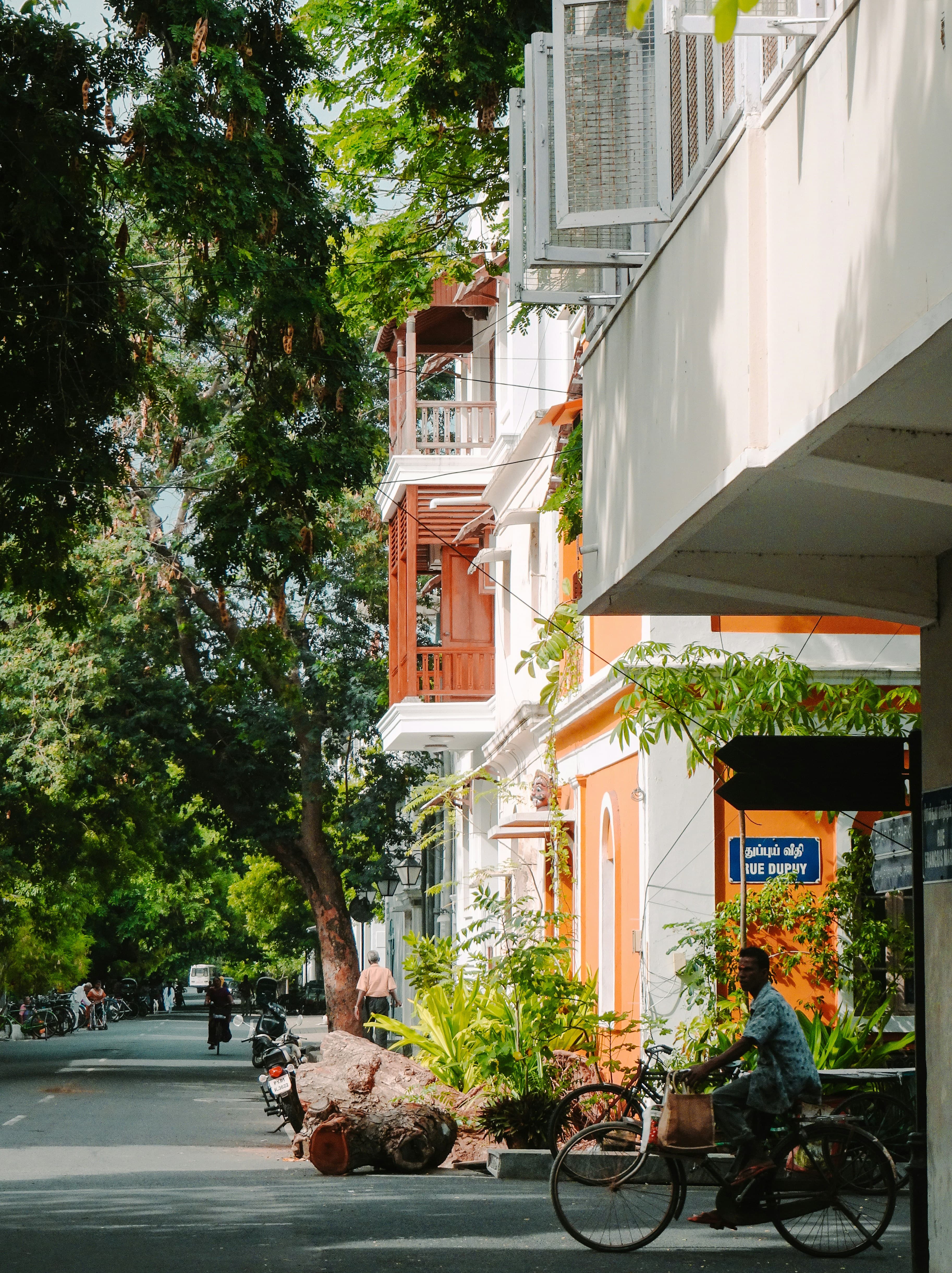
Monument & Street
Walking Tour of White Town
French: Promenade en Ville Blanche
Built: Colonial era (17th–20th c.)
A two-kilometre loop through the only French colonial town in India that survived decolonisation intact. Orange research institutes, a seafront church where Mass is said in three languages, a statue of the man who almost made France master of the subcontinent, and a poet's park at its heart. Allow two hours. Bring water. Start early.
Where to begin. Start at the Institut Français de Pondichéry on Rue Dumas, the large orange building that announces itself before you can read the sign. That colour is deliberate: French institutional architecture had a habit of stating its presence in warm, saturated ochre, and this building, one of the few active French research centres in India, is a reminder that French Pondicherry did not end with decolonisation. It continued as scholarship. The Institut publishes the finest heritage map of White Town; ask at the reception before you set off.
The seafront and its monuments. Walk east to Goubert Avenue, the promenade that faces the Bay of Bengal. The French War Memorial stands here, tended still by the French Consulate, dedicated to the residents of French India who died for France in the First World War: Tamil soldiers who fought at Verdun and Gallipoli under a tricolour they may never have seen before they sailed. Across the road, the Mahatma Gandhi Statue stands within a ring of granite pillars, a white structure facing the sea, on the same avenue where French governors once processed in ceremony. A short walk south, the statue of Joseph François Dupleix faces the water: the man who governed Pondicherry from 1742 to 1754 and nearly made France the dominant power in India. He was recalled by his own company, died broke in Paris, still fighting his creditors. His statue outlasted the empire he built.
Joan of Arc, in the tropics. Between the seafront and Notre-Dame des Anges, a small garden holds a marble Joan of Arc, armoured, carrying a battle standard, donated by French politicians and businessmen in April 1923. She expelled the English from France. The British had razed this very city to the ground in 1761. The choice of subject was not accidental.
Le Café, at any hour. On the promenade, Le Café is the oldest French cafe in Pondicherry, open twenty-four hours a day, a fact which becomes useful if you arrive before dawn to walk the seafront as the fishermen haul in their nets. Sit facing the sea, order coffee, and watch the bay go from black to grey to gold. By the time your cup is empty, the city will have woken up around you.
The church of three languages. Notre-Dame des Anges, whose twin cream towers you can see from the promenade, has stood on this seafront site since 1687, rebuilt four times, and consecrated in its present form in 1855. It is the only church in Pondicherry where Mass is celebrated in Tamil, English, and French, the three languages of the city's three centuries. Twenty-eight stained-glass windows were shipped from France and installed in a building made of local coral stone. Morning Mass begins at 5:30am. The gates close at 8:00pm. The marble Joan of Arc in the garden outside faces east, toward the rising sun, toward the sea that brought everyone here.
The scholars who stayed. Walk back into the grid and you find the intellectual institutions that are, arguably, the most enduring thing France left in Pondicherry. The École française d'Extrême-Orient, known universally as EFEO, founded in Hanoi in 1900 and present in Pondicherry since 1955, is dedicated to the study of Asian civilisations. Its scholars have documented temples, inscriptions, and manuscripts across India, Southeast Asia, and East Asia. UNESCO has recognised its work on Indian art, architecture, and literature. This is not a colonial archive gathering dust; it is an ongoing centre of living scholarship. The Alliance Française de Pondichéry, a short walk away, runs language courses and cultural programmes that have been the city's French cultural hub for decades. These are not monuments to a departed empire. They are working institutions.
The oldest church in the quarter. The Immaculate Conception Cathedral, known locally as Samba Kovil (Tamil for Saint's Church), is one of the oldest churches in Pondicherry. Its plainer, more austere character reflects the earlier French presence: before the stained glass and the twin towers, before the grand civic ambitions of the nineteenth century. The walls carry more history than the signage admits. Walk past slowly.
The man who wrote the constitution. The B.R. Ambedkar Mani Mandabam stands as a tribute to Dr. B.R. Ambedkar, the jurist, economist, and social reformer who drafted the Constitution of India. It is fitting that a city whose identity rests on the coexistence of the French, the Tamil, and the Indian should dedicate a building to the man who gave India its constitutional framework for equality. He would have understood this city.
The Lycée. The Lycée Français International de Pondichéry educates children from the age of three to eighteen in the French national curriculum, the only such school in South India. French families, Tamil families, and international residents send their children here. The school is a living reminder that French Pondicherry is not purely a historical subject. It is a present one.
The park that was Napoleon's square. Bharathi Park is the ceremonial heart of White Town: the open square surrounded by Raj Nivas to the north (the Lieutenant Governor's official residence, once the palace of the French Governor), the Legislative Assembly, the Secretariat, and the Puducherry Museum. At its centre stands the Aayi Mandapam, four Greco-Roman columns under a domed roof, built under Napoleon III to honour a Tamil woman named Aayi who demolished her own house to provide water for the city, centuries before the French arrived. European stone, Indian legend. The park is open from 6:00am to 8:00pm. Entry is free. Sit on a bench in the morning and watch the city go through its routines: joggers, vendors, schoolchildren, retirees reading newspapers in the shade of mango trees.
The museum that rewards slowness. The Puducherry Museum, at the north-east corner of Bharathi Park, holds 81 Chola bronze sculptures of international calibre, Roman pottery imported from Italy two thousand years ago, Franco-Tamil colonial furniture, and a vehicle that the poet Subramania Bharathi is said to have loved. It costs ten rupees to enter and rewards ninety minutes of unhurried attention. Open 10:00am to 5:00pm. The bronze gallery alone is worth the walk.
After the tour. The streets of White Town are at their best before 10am: soft light, cool air, shutters just opening, the smell of jasmine over coral-stone walls. When the heat builds, the quarter's deep verandahs and tall-ceilinged heritage cafes offer shade and strong coffee. Take any random turn off the main route and you will find beauty in every direction. Nowhere else in India does a town like this survive so intact, so alive, and so quietly magnificent.
What to look for
- The Institut Français de Pondichéry on Rue Dumas: the orange building is your starting point. Pick up their heritage map at the reception before you set off, it is the best guide to the grid.
- Dupleix and Gandhi share the same promenade: colonial ambition and the independence that ended it, neither erasing the other. Stand between them and face the sea.
- Notre-Dame des Anges: the only church in Pondicherry where Mass is celebrated in Tamil, English, and French. Arrive early and you may catch the 5:30am service before the tourists wake up.
- The Aayi Mandapam at the centre of Bharathi Park: four European columns over an Indian legend. Read the plaque slowly. The story is better than the architecture.
- The Puducherry Museum: ten rupees, 81 Chola bronzes, Roman pottery from Italy, and one vehicle that Subramania Bharathi loved. The least-visited world-class museum in South India.
Hours: Streets open 24h; best walked 6:00–10:00 AM. Notre-Dame des Anges: 5:30 AM–8:00 PM. Bharathi Park: 6:00 AM–8:00 PM. Puducherry Museum: 10:00 AM–5:00 PM
Entry: Free (Puducherry Museum: ₹10 adults, ₹5 children)
Tip: Start at the Institut Français on Rue Dumas and walk clockwise toward the sea. Allow two hours for the monuments and add ninety minutes if you enter the Puducherry Museum. Le Café on the promenade is open twenty-four hours and makes a good breakfast stop before the heat builds.
The Pondy App
Take this guide with you
Offline maps, street-level history, restaurant picks, and hotel guides — everything on this site, in your pocket.