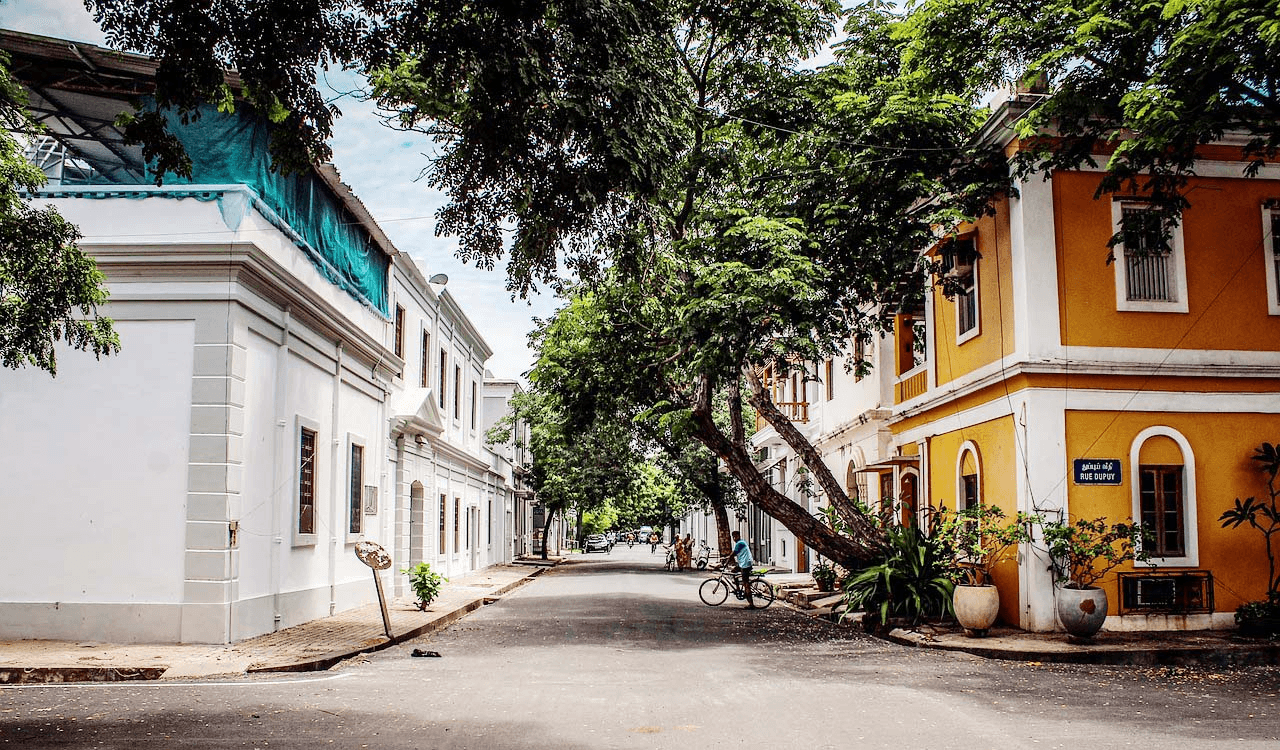
North–South Street
Bharathi Street
Also known as: Rue Bharathi
Named after: Subramania Bharati (1882–1921), Tamil poet and nationalist who lived in Pondicherry from 1908 to 1919 (1882–1921)
Welcome to Bharathi Street, named after Subramania Bharati, the greatest Tamil poet of the modern era, who lived in Pondicherry from 1908 to 1919 as a fugitive from British India and wrote some of the finest poetry in the Tamil language in a small house near the seafront. French territory protected him. He used the time well.
Subramania Bharati arrived in Pondicherry in 1908, having calculated that arrest for his revolutionary journalism in Madras was imminent. French territory offered what British India could not: immunity from extradition for political offences. He took a house on Eswaran Koil Street and began writing at extraordinary pace.
The Pondicherry years were the most productive of his life. Panchali Sabatham (1912), an epic poem retelling the Mahabharata episode of Draupadi's vow and reinterpreted as an allegory of India's subjugation and coming liberation, was immediately celebrated as a masterwork. Kuyil Pattu, his lyric sequence, brought formal innovation to Tamil literary tradition. Kannan Pattu, his devotional songs to Krishna, are still sung across Tamil-speaking communities worldwide. He lived in poverty, supported by journalism and friends' charity, but wrote without stopping.
He and Sri Aurobindo lived close to each other in the White Town during these years. The two men, both political exiles turning inward, met occasionally. Bharati translated some of Aurobindo's English writings into Tamil. The city was sheltering two of the most significant Indian cultural figures of the early twentieth century at the same time, on the same small streets, under the same French flag.
He returned to British India in 1919, was briefly arrested, and died in Madras in September 1921, aged thirty-eight. His birthday, 11 December, is observed across Tamil Nadu as Tamil Poet Day. His house on Eswaran Koil Street is maintained as a heritage site. Bharathi Park, the central garden of the White Town, bears his name.
Notable on this street
- He lived in Pondicherry from 1908 to 1919. The same French legal protection that sheltered Sri Aurobindo two years later sheltered Bharati first.
- Panchali Sabatham (1912): the Mahabharata episode of Draupadi's vow, reinterpreted as an allegory of colonial India. Immediately celebrated as a masterwork. Read in Tamil schools to this day.
- He and Sri Aurobindo were neighbours in the White Town during these years. Bharati translated some of Aurobindo's English writings into Tamil.
- He died aged thirty-eight, in 1921, of injuries from a temple elephant he had befriended at the Parthasarathy Temple in Madras. His birthday is Tamil Poet Day across Tamil Nadu.
The Pondy App
Take this guide with you
Offline maps, street-level history, restaurant picks, and hotel guides — everything on this site, in your pocket.