Colonial Heritage
White Town (Ville Blanche)
French: Ville Blanche
Built: 17th–20th century
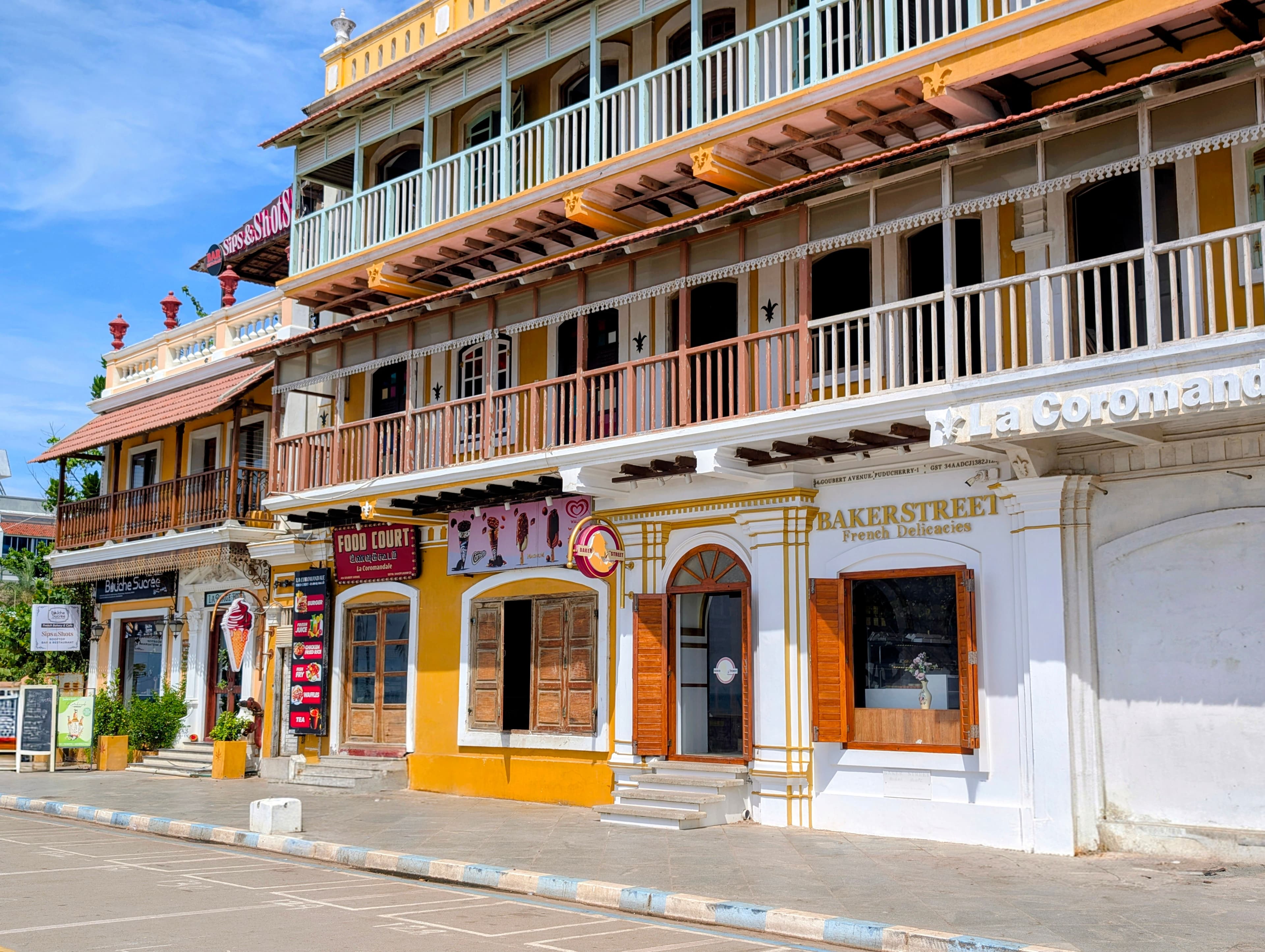
A grid of ochre-yellow coral-stone mansions, bougainvillea walls, and streets named Rue Dupleix, Rue Suffren, Rue Bussy. The best-preserved French colonial streetscape in the world, built on a Dutch plan, filled with French names, in a city that is now part of India.
Step into the oldest street in French India.
Walk north on Rue de la Marine, the street named not for a person but for the sea itself, the institution without which Pondicherry could not have survived. It is early morning. The air is cool from the Bay of Bengal, heavy with jasmine and the faint salt of last night's tide. Yellow walls rise on both sides of you, their plaster smooth and warm in the new light. Bougainvillea falls in purple cascades over coral-stone balconies. Somewhere down the block, someone is unlocking shuttered windows. Green wooden shutters, eight feet tall, painted the colour of old bottle glass. They creak open. The morning sounds arrive: a bicycle bell, a temple bell, a distant call to prayer.
You have just stepped into the best-preserved French colonial streetscape anywhere on earth. But the deeper truth is that you have stepped into something far stranger. The grid you are walking was not designed by the French. The buildings are not from Dupleix's time; they were rebuilt after the British destroyed the city in 1761. The street you are on was walked by a Tamil broker who wrote in Tamil, and whose diary is the finest portrait of the French colonial world we have. Nothing about the White Town is simple. Everything about it is astonishing.
Before the French, before everyone
This coast was ancient before any European arrived. The Romans came first, or close enough. Three kilometres south of where you are standing, the Ariyankuppam river meets the Bay of Bengal at a site called Arikamedu, and in the mud of that ancient port, archaeologists found Arretine pottery: red-glaze tableware made in Arezzo, Italy, stamped with the potters' marks of men who were alive when Augustus was emperor. Not local imitations. Originals. Shipped from Italy to this precise coast, roughly two thousand years ago. The Tamil Sangam poets wrote of yavanas, Romans, arriving with ships full of wine and departing with pepper and fine cloth. Pondicherry was a world city before it was a French one.
The Pallavas held this coast, then the Cholas, then the Pandyas, then Vijayanagar, then the Sultanate of Bijapur. The local Tamil name meant simply "new town," Puducherry: a place that had already reinvented itself many times before the Europeans arrived. When a young French merchant named François Martin first looked upon this flat coastal strip in 1674, what he saw was a fishing village on a dune ridge, backed by a lagoon and a canal, stretching toward the interior. He saw something else too. He saw that it could be held.
The six men who built a city
The scene is almost impossible to believe. It is September 1674. San Thomé, the stronghold north of Madras that France had briefly held, has just surrendered to the Dutch. The French admiral has sailed away. Martin's superior has been recalled. Martin is left at Pondicherry with six men. Six men and a fishing village on the most treacherous, surf-beaten, harbourless shore in the Indian Ocean.
His patron, the local governor Chirkhan Loudy, advises him to leave. Everyone advises him to leave. Martin stays. His reasoning, recorded in his Mémoires, is precise and almost beautiful in its clarity: if France abandons this site, they will never be permitted to return, and the Dutch will immediately occupy it. So he stays. He writes letters. He negotiates. He cultivates Chirkhan with the patience of a man who understands that what he is building will take decades, not months. The Dutch send six warships in 1678. Martin, with thirty-three men of whom two are invalids, prepares the defences and waits. The Dutch commander hesitates. Weeks pass. The Peace of Nijmegen arrives from Europe like a reprieve. The Dutch sail away.
This is the true founding moment of the White Town. Not a declaration, not a ceremony, but a man who refused to leave.
Martin spent the next three decades building. Streets, a fort, a canal, a textile industry. He died here on 30 December 1706 and was buried in Fort Saint-Louis. He never returned to France. He had left Paris in 1665 at the age of thirty, and this city was his only home for forty years. A street bears his name: Rue François Martin. Walk it one morning and think of the man who held this place with six soldiers while an admiral sailed away.
The city that talked to Versailles
Under Martin's successors, Pondicherry grew quietly. But it was Joseph François Dupleix, arriving as Governor-General on 15 January 1742 to twenty-one cannon salutes, who turned this modest colonial capital into something that the court of Versailles could not ignore.
Dupleix had a theory. He had spent years at Chandernagor in Bengal, watching the Mughal Empire dissolve into succession crises, watching Indian princes fight each other with armies that could be tipped by a few hundred European-trained soldiers. He understood what his superiors in Paris consistently refused to accept: that military presence was the precondition for commercial dominance, not a costly distraction from it. Back the right Indian prince with French troops, and you collect not just trading rights but territory, revenue, and sovereignty.
He began to practise it. By December 1749, the new Nizam of Hyderabad, Muzaffar Jang, came to Pondicherry in person, to the Government Palace on the edge of Bharathi Park, to acknowledge his French protector. Indian princes came to these streets to negotiate. Mughal imperial envoys were received in this city. The Mughal Emperor's formal grant made Dupleix Nawab and Governor of all of southern India from the Krishna River to Cape Comorin. Pondicherry was, on paper, the capital of the Deccan.
An anonymous witness wrote in 1746: "Everyday, when he leaves home, he is preceded by two flags and an escort of a dozen mounted guards. When he marches in ceremony, he is preceded by more than a hundred troopers and three elephants, upon which his flags are carried, and his coach is followed by a crowd of horsemen and jesters." This was not vanity. It was calculated policy. To be recognised by Indian rulers as a sovereign actor, you had to look like one. Dupleix looked like one. And Pondicherry, for a brief and glittering decade, was the jewel of it: talked about in Versailles, feared in Madras, astonishing to every traveller who arrived by small boat through the Coromandel surf.
The Governor of Madras, Saunders, wrote to the British East India Company in February 1751: "The French are striving to establish themselves in the most convenient places on the coast and are laying the foundations of an advantageous trade without the slightest regard for the interests of their neighbours." Robert Clive, a former bookkeeper turned military commander, dismantled the French position in the Carnatic piece by piece. Paris chose dividends over empire. In October 1754, Dupleix departed Pondicherry aboard the Duc d'Orléans. He was never coming back. He spent his last nine years in Paris fighting the Compagnie for compensation and died broke in 1763, the case still open. The bronze statue on Goubert Avenue shows him as he was in his prime: facing the sea, toward the ships that brought his rise and carried him home in disgrace. He stands in Indian soil. The empire he almost built became someone else's. His statue is still here.
The man who watched it all and wrote it down
To understand Pondicherry in Dupleix's time, you need one book: the Private Diary of Ananda Ranga Pillai, twelve volumes in Tamil, written by the man who was closer to Dupleix than any other person alive.
Pillai was the dubash, the chief broker and interpreter of the French establishment. The word combines Tamil roots for "two languages," but the role was far more than translation: he managed the Indian-side of all commercial operations, extended credit, negotiated with local officials, and served as the social intelligence service of the entire colony. His diary records everything. The Governor's moods. The movements of French officers. The gossip of the bazaar. The private conversations with Dupleix himself, reported at length with a candour that no official document could match. When Dupleix speaks bitterly of his rival La Bourdonnais, Pillai records it in direct speech: "He is an utterly petty-minded man, and one entirely regardless of the blow which the honour of the French has sustained."
But Pillai also wrote one of the most beautiful passages in the history of French India, comparing the three governors he had served to gardeners: "Monsieur Lenoir worked like a gardener. He enriched the earth, ploughed, fertilised and prepared his crops. He planted trees which blossomed and whose fruit he enjoyed during his time. Monsieur Dumas simply devoured the produce. In Monsieur Dupleix's time, a tempest devoured the garden."
His house still stands in the White Town. Tamil floor plan around inner courtyards, fine woodcarving from Tamil craftsmen, French colonial proportions on the upper storey. Walk past it and understand that this is what the White Town actually was: not French, not Tamil, but something that had never existed anywhere else on earth.
The year everything was destroyed
16 January 1761. The British enter Pondicherry. They do not occupy it. They level it.
This is the fact that rewrites everything you think you know about the White Town. The buildings you are admiring today are not Dupleix's buildings. They are not even the buildings that François Martin built. The British spent three months systematically demolishing the entire city, down to the foundations. The palace, Fort Louis, the churches, the warehouses: all gone. It was not damage; it was policy. The goal was to ensure France could never recover a functioning base on the Coromandel Coast.
Governor Law de Lauriston arrived in 1765 to find rubble where a city had been. He reportedly rebuilt 200 European and 2,000 Tamil houses within five months, following the old street pattern, because the streets themselves were the city's memory. The grid survived. The walls did not. And here is the deeper irony: even that celebrated grid was not French. Jean Deloche's meticulous analysis of 279 colonial-era plans established that the orthogonal chessboard layout of the White Town was designed during the Dutch occupation of 1693 to 1699. The French recovered the city in 1699 and simply followed the plan. The names on the streets are French. The grid beneath them is Dutch.
The ochre-yellow coral-stone mansions you walk past today, their shuttered facades painted mustard and cream and pale gold, largely date from the peaceful century after 1816. They are Restoration-era buildings on a Dutch grid, in a city that remembers everyone who ever came here.
The philosopher and the poet
The French colonial city had one extraordinary quality: it was the only territory on this coast that the British could not touch. In the early twentieth century, two great Indians chose it for that reason.
The Tamil poet Subramania Bharati arrived in 1908, fleeing British prosecution for his revolutionary journalism. He wrote his most celebrated poems in these streets, sustained by the strange safety of foreign soil.
Then came Sri Aurobindo. On 4 April 1910, the philosopher and former revolutionary nationalist stepped off a ship in Pondicherry harbour. The ship was called the SS Dupleix: history's small, precise joke. He had slipped out of Calcutta in secret to escape a third sedition prosecution. French territory meant France could not hand him over. Britain watched. He stayed. He never left. He withdrew into silence, yoga, and philosophy. The Ashram he established in 1926 became a city within the city. The flowers on the samadhi in the main courtyard are replaced around the clock by pilgrims who come from across India. Stand there one morning. The silence is genuine.
The streets that survived everything
When Pondicherry passed to India on 16 August 1962, a remarkable thing happened: nothing happened to the street signs.
Rue Dupleix survived. Rue Bussy survived. Rue Lally-Tollendal survived, named for the French commander who surrendered this city in 1761, was tried for treason in Paris, and was beheaded. His street sits alongside those of his colleagues; the White Town's memory is complete, not selective. The signs are bilingual today: French name above, Tamil transliteration below, on every corner. Pondicherry is the only city in India where French colonial street names survived decolonisation intact.
How to walk it
You have about two hours before the heat builds and the streets fill with traffic. Start at Notre-Dame des Anges on the seafront and walk south along Rue Dumas. Look at the facades: coral stone, lime plaster, shuttered windows painted in green and blue and white. The stone is local, quarried from underwater coral reefs; the craftsmanship is Tamil; the proportions are French. Nothing is purely one thing. Turn west on Rue Dupleix. The Romain Rolland Library, founded in 1827, holds 400,000 volumes and the memory of a city that read in three languages. Bharathi Park occupies the space where Mughal envoys once approached the Governor's Palace. The Aayi Mandapam at its centre, four classical columns under a dome, honours a Tamil courtesan named Aayi who demolished her own house to build a water tank for the city, and whom Napoleon III thought worthy of a permanent Greco-Roman monument. European columns, Indian story.
Come back at dusk. The low granite parapet along the seafront will be full of people: the whole city comes to breathe here at the end of the day. The light goes gold on the ochre walls. The Bay of Bengal darkens. A priest at Notre-Dame des Anges locks the side gate. Someone is playing music in a courtyard behind you. Two elderly women are sharing the steps of the Dupleix statue's base, not looking at the bronze at all, just watching the sea.
This city has been watching the sea since the Romans brought wine from Italy and left with pepper and fine cloth. It will still be watching long after you have gone.
What to look for
- Walk Rue de la Marine first: the street closest to the sea, named not for a person but for the institution without which Pondicherry could not have survived. The Sri Aurobindo Ashram's main building faces it today.
- Ananda Ranga Pillai's house: Tamil courtyard plan, French colonial facade. The finest example of cross-cultural domestic architecture in the city, and the home of the man whose diary is the most intimate record of Dupleix's Pondicherry.
- Look at the street signs: bilingual French and Tamil, side by side. Pondicherry is the only city in India where French colonial street names survived decolonisation intact.
Hours: Open streets; best explored 7:00–10:00 before traffic
Entry: Free
Tip: The entire quarter is walkable in 2–3 hours. Start at Notre-Dame des Anges and walk south along Rue Dumas, then cut west on Rue Dupleix. Pick up a heritage map from the tourist office or the Institut Français.
The Pondy App
Take this guide with you
Offline maps, street-level history, restaurant picks, and hotel guides — everything on this site, in your pocket.