Nature & Garden
Bharathi Park
French: Place du Gouvernement
Built: Colonial era (redesignated post-1962)
The ceremonial heart of French Pondicherry, and its oldest public garden. Eight acres of shaded lawns, Greco-Roman columns, and a poet's bronze likeness looking out over the same square where colonial governors once received Mughal envoys. Come for the morning walk; stay for everything else.
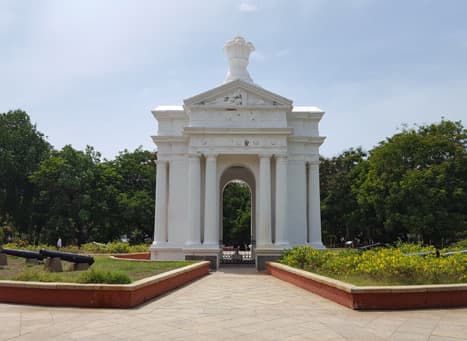
Before the French, before the British. The oldest story in Bharathi Park has nothing to do with Europeans. A courtesan named Aayi demolished her own house and used the land and her savings to build a water tank for the city, centuries before any flag arrived. The French colonial administration, under Napoleon III in the 1850s, built a Greco-Roman pavilion at the centre of their principal public square to commemorate her. Four white columns. A domed roof. A Tamil legend preserved in European stone. They named it the Aayi Mandapam, and it still stands at the park's centre today, one of the most photographed structures in Pondicherry.
Napoleon's garden. The French laid out this green space as the ceremonial core of their colonial capital, the open square between the Governor's palace, the Legislative Assembly, and the administrative buildings. They called it Place du Gouvernement, though locals knew it informally as Napoleon Park. When Dupleix received Indian princes and Mughal envoys at the palace to the north, this square was the formal approach. Raj Nivas, the Legislative Assembly, the Secretariat, the Puducherry Museum: all of them face this park. Three centuries of power, arranged around a garden.
The poet takes the square. After 1962, the Place du Gouvernement became Bharathi Park, renamed for Subramania Bharathi, the Tamil poet, journalist, and freedom fighter who lived in Pondicherry from 1908 to 1919. He used French territory as a legal sanctuary from British arrest, writing some of his most celebrated verse in exile on these streets, the same legal loophole that sheltered Sri Aurobindo. A bronze statue of Bharathi now stands at the park entrance: not a soldier, not a governor, but a poet. The square that once symbolised French authority now carries the name of the man who helped dismantle it.
The park today. Eight acres of manicured lawns, wide sandy walkways under a canopy of mango, tamarind, and banyan trees, colonial-style benches, and flowerbeds that shift colour with the seasons. Small water features draw birds into the shrubbery: sparrows, doves, and if you arrive early enough, a kingfisher or a sunbird in the flowering shrubs. Butterflies move between the blooms. Families on Sunday mornings, joggers before the heat builds, retirees reading newspapers on shaded benches: this is what a city park is supposed to feel like. Cultural events run here through the year, music concerts, poetry readings, seasonal flower shows. And every evening, the musical fountain runs with synchronised lights and sound. Free. Open to anyone. The best show in White Town.
What to look for
- The Aayi Mandapam at the park's centre: four classical columns, a domed roof, a Tamil legend in European stone. Built under Napoleon III to honour a woman who lived here centuries before him. Read the story on the plaque slowly.
- Look north to Raj Nivas (formerly Lok Nivas): the building Dupleix governed from in the 1740s still faces this park. Three sovereignties; same view.
- Evening: the musical fountain runs with synchronised music and dancing lights. Free, open to everyone, the best show in White Town.
- Morning: arrive before 8am and you share the walkways with local joggers, yoga groups, and elderly residents reading the newspaper under the palms. The park before the heat is a different place.
- The park sits at the centre of Pondicherry's administrative and cultural core. The Puducherry Museum is a 2-minute walk to the east; Rock Beach is 5 minutes on foot to the north. Four landmark buildings visible from one bench.
Hours: Open daily 6:00 AM to 8:00 PM; musical fountain runs in the evenings
Entry: Free
Tip: Two visits are better than one: mornings for the cool air, birdsong, and local life under the palms; evenings for the fountain and the golden light on the colonial facades. November to February is the sweet spot, lower humidity and manageable heat. The park covers 8 acres, larger than it looks from the entrance.
The Pondy App
Take this guide with you
Offline maps, street-level history, restaurant picks, and hotel guides — everything on this site, in your pocket.