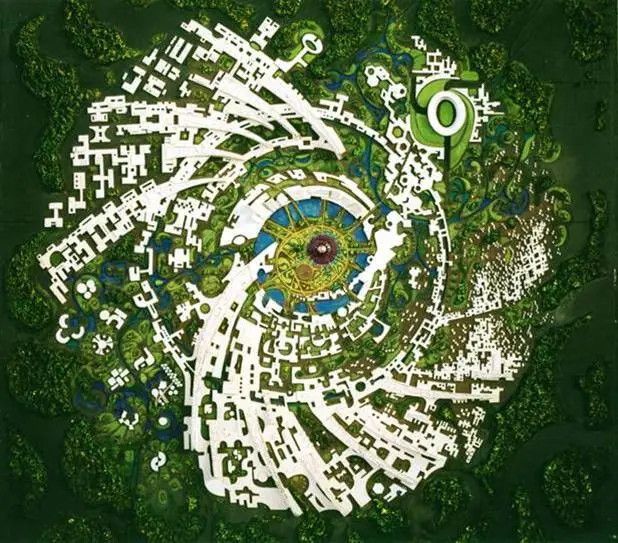
Auroville
What is Auroville?
Founded in 1968 as an experiment in human unity, Auroville is home to around 3,400 people from more than 60 countries. It is not a tourist attraction, a spiritual retreat, or a commune. It is something harder to define.
The founding
On 28 February 1968, a ceremony took place on a plateau of eroded land about 12 kilometres north of Pondicherry. Representatives of 124 nations and the States and Union Territories of India placed soil from their homelands into a marble-clad urn at the centre of the site.
Mirra Alfassa, known as The Mother, sent a message that was read aloud: "Auroville wants to be a universal town where men and women of all countries are able to live in peace and progressive harmony, above all creeds, all politics and all nationalities."
More than half a century later, that statement remains Auroville's founding charter.
Not a spiritual retreat
Many visitors arrive expecting an ashram or a religious community centred on the teachings of Sri Aurobindo. Auroville grew from the vision of Sri Aurobindo and The Mother, but it has no official religion, no required belief system, and no prescribed form of worship.
The Matrimandir, at the centre of the township, is intended for silent individual concentration rather than prayer or religious ceremonies. Residents include architects, engineers, artists, farmers, teachers, scientists and entrepreneurs from many parts of the world, united by a shared commitment to the experiment rather than a common faith.
How it works
Auroville is administered by the Auroville Foundation, a statutory body established under the Auroville Foundation Act, 1988, passed by the Parliament of India. UNESCO has passed a series of resolutions supporting Auroville since its founding, but it does not govern the township.
Today, Auroville has around 3,400 permanent residents representing more than 60 nationalities, though the number shifts as people join or leave. Many residents receive community maintenance or earn incomes through Auroville's farms, schools, workshops, research organisations and commercial units, while contributing to the township's shared services.
The land
When the first residents arrived in the late 1960s, much of the surrounding plateau had been stripped of its original vegetation by centuries of fuel collection, grazing and erosion.
Over the following decades, residents and volunteers planted more than two million trees, restored large areas of Tropical Dry Evergreen Forest, built check dams, and introduced rainwater harvesting to slow erosion and improve groundwater recharge.
Many of the shaded roads and forests that visitors experience today did not exist when Auroville was founded. Ecological restoration remains one of the township's defining achievements.
Why visit
Auroville is best experienced slowly. The Matrimandir is its best-known landmark, but it is only one part of a township spread across about 20 square kilometres of forests, farms, workshops and residential communities.
Spend time beyond the Visitors' Centre. Walk or cycle the forest roads, visit a workshop, eat at the Solar Kitchen. A conversation with someone who arrived twenty years ago and never left will tell you more about what Auroville actually is than any exhibition. These encounters are not arranged. They happen at lunch, on the forest roads, at a café table. That is how the place works.
The Pondy App
Take this guide with you
Offline maps, street-level history, restaurant picks, and hotel guides — everything on this site, in your pocket.